
There is a particular kind of morning that feels different from all the others.
You wake before the alarm. The house is still. The light through the curtains is soft and unhurried. And before the phone, before the news, before the first demand of the day reaches you — there is a moment. A few seconds of pure, open silence.
Most of us let that moment slip away without noticing. But what if a single painting on your bedroom wall could teach you to hold it?
The Forgotten Power of Sacred Art in Private Spaces
For most of human history, people understood intuitively that the images surrounding them shaped the quality of their inner life. Sacred art was not confined to churches and temples — it lived in homes, in bedrooms, above doorways, beside beds. It was present at the beginning and end of every day, a quiet constant in the rhythm of ordinary life.
That tradition has faded in the modern world, replaced by mass-produced prints, motivational posters, and the glowing rectangles of our screens. We have filled our walls without really thinking about what we are putting there — or what it is doing to us.
But something is shifting. More and more people, across many different spiritual backgrounds, are rediscovering the value of placing genuinely meaningful art in their most personal spaces. Not as decoration. As intention.
Why the Morning Moment Matters
The first few minutes after waking are among the most psychologically significant of the entire day. Sleep researchers and contemplative traditions alike have long recognized that the transition from sleep to wakefulness is a threshold — a moment of unusual openness in which the mind has not yet fully armored itself against the world.
What you encounter in that threshold shapes your inner weather for hours afterward.
A phone notification pulls you immediately into reactivity — into other people’s urgencies, other people’s stories, other people’s noise. But a painting — a single, carefully chosen image on the wall across from your bed — offers something entirely different. It offers a place for your eyes to land softly. A visual breath before the day begins.
For those who pray, that moment can become the natural opening of a morning prayer. For those who meditate, it can serve as a focal point for the first few breaths of the day. And for those who simply seek a moment of stillness before the world begins its demands, a meaningful painting can become a kind of daily anchor — wordless, patient, always there.
What Happens When Art Becomes Part of Your Ritual
Ritual works through repetition. The more consistently you return to the same image, the same corner, the same quality of attention — the more deeply your mind begins to associate that image with stillness, with depth, with the particular quality of feeling you bring to it.
Over time, a painting you see every morning stops being merely a visual object. It becomes a cue. A doorway. You glance at it and something in you quiets almost automatically, the way a familiar piece of music can return you instantly to a particular feeling or memory.
This is not mysticism — it is how the mind works. And it is why the paintings you choose for your bedroom, and particularly for a morning ritual space, deserve far more thought than most of us give them.
Choosing a Painting That Can Hold That Weight
Not every painting is suited to this role. A morning ritual painting needs to be able to bear repeated viewing without becoming exhausted — without losing its capacity to move you, to quiet you, to invite you inward.
The paintings that do this best tend to share certain qualities.
Depth over decoration. A painting chosen purely for its colour coordination with your duvet will not sustain a spiritual practice. You need something with genuine inner life — something that rewards sustained attention, that offers something new each time you look at it.
A quality of presence. The greatest sacred paintings feel inhabited. There is something in them that seems to look back — not literally, but in the sense that the painting seems aware, alive, attentive. This quality is almost impossible to manufacture and immediately felt when it is real.
Emotional honesty. The best paintings for a prayer or contemplation space do not sentimentalise. They do not offer easy comfort or shallow brightness. They hold something true — something that acknowledges the full weight of human experience while pointing toward something beyond it.
A figure or subject you can return to. For many people, a painting with a central figure — a face, a posture, a gesture — works better as a daily ritual anchor than an abstract or landscape. There is something about the human form, or about a face that carries spiritual depth, that invites sustained, personal engagement in a way that other subjects do not always match.
A Painting That Transforms the Room It Enters
Among the bedroom paintings that carry this quality of presence most powerfully, figurative devotional works stand apart.
Consider what it means to wake each morning to a portrait of genuine spiritual depth — a face that holds both sorrow and serenity, both humanity and transcendence. A painting like this does not demand anything of you. It simply waits. And in waiting, it creates space.
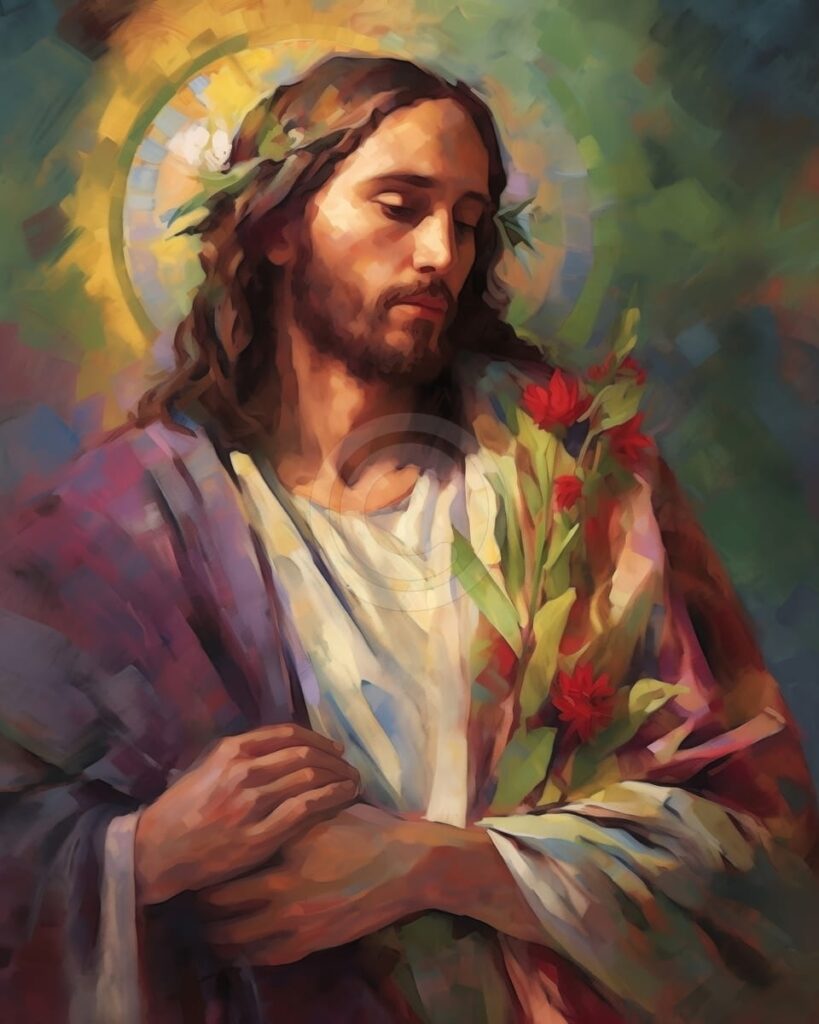
Jesus Portrait is one such painting — a handmade original canvas work that brings exactly this quality into a room. The portrait carries the kind of stillness that only original art can hold: the texture of the brushstroke, the weight of the canvas, the presence of a human hand behind every mark. Hung at eye level from the bed, or placed in a quiet corner of the bedroom, it becomes more than a painting. It becomes a companion for the morning threshold — something to look at before words begin, before the day’s demands arrive, before anything is required of you except to be present.
Building a Morning Ritual Around Your Painting
Once you have chosen a painting that speaks to you, building a simple morning ritual around it requires very little.
Place it where your eyes naturally fall. The wall directly facing your bed, or the one your gaze moves to in the first moments of waking, is the most powerful position. You want the painting to be the first meaningful thing you see — not stumbled upon after you have already picked up your phone.
Give it good light. Morning light, if your room receives it, is ideal. If not, a warm-toned lamp positioned slightly to the side will bring the painting alive without the harshness of overhead lighting.
Create a moment of stillness before you move. You do not need an elaborate practice. Even thirty seconds of simply looking — of letting your eyes rest on the painting, of breathing slowly and not reaching for anything — is enough to shift the quality of your morning. Over time, that thirty seconds becomes a minute. The minute becomes a natural prayer. The prayer becomes the foundation of your day.
Keep the space simple. A candle nearby. A small plant. Perhaps a meaningful object on the bedside table. Nothing more. The painting should be the centre of gravity in this space — everything else should serve it, not compete with it.
Beyond the Bedroom: Art as a Daily Spiritual Practice
What begins with a single painting in a bedroom can become something larger — a whole approach to living in which the images around you are chosen with the same care you bring to the words you read or the company you keep.
If you find that one painting transforms your mornings, you may find yourself wanting to extend that intention to other rooms, other moments in the day. A painting in the hallway that greets you when you return home. A small canvas in your workspace that anchors you during difficult hours. A piece in the living room that opens something in you when the house is quiet in the evening.
For those beginning this journey, exploring a curated collection of handmade original works is the natural starting point. PastelBrush’s bedroom art collection brings together original canvas pieces painted by hand — devotional figurative works, soft landscapes, and quietly spiritual abstracts — each one created with the care that only original art carries. Browsing it is itself a kind of meditation: a slow, attentive looking that is already, in its own way, a practice.
Final Thoughts
We tend to think of transformation as something that requires grand gestures — pilgrimages, retreats, dramatic changes of circumstance. But some of the deepest shifts in a life happen quietly, through the slow accumulation of small, intentional choices.
Hanging a meaningful painting in your bedroom is one of those choices.
It costs very little. It changes nothing visible about your circumstances. And yet, morning after morning, it is there — patient, present, wordless — offering you a threshold to cross before the day begins. A moment to remember, before anything else, what you are and what you are here for.
That is what art, at its most powerful, has always done. Not to decorate a life, but to deepen it.
