
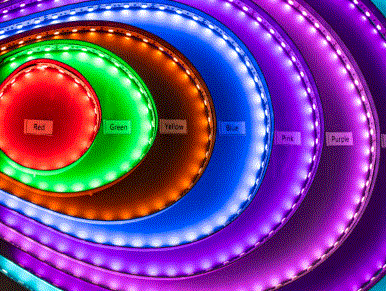
LED strip lighting can be used for architectural accents, signage, indoor decoration, retail displays, entertainment spaces, and many other projects. However, different installations require different combinations of voltage, LED density, waterproofing, brightness, and cutting flexibility. Choosing the right strip starts with understanding the technical requirements of the application.
For businesses looking for dependable products, a professional LED strip lights manufacturer can provide multiple strip configurations for different project requirements. Shenzhen Dekingled Co., Ltd., established in 2014, offers several LED strip formats designed for decorative, architectural, commercial, and specialty lighting applications.
Consider the Required Voltage
Voltage is one of the first specifications to check before selecting an LED strip. The product must be matched with a compatible power system to operate correctly.
For example, the 3528 LED strip supports 12V DC and 24V DC input voltage and has a maximum power consumption of 4.8W per meter. It also uses 300 LEDs across a 5-meter strip and has an IP65 protection rating.
Other products are designed for different electrical requirements. The 2835 high-voltage strip operates at AC220V, contains 550 LEDs per 5 meters, and has a maximum power rating of 10W. It can be cut by 11 LEDs and reconnected using the appropriate accessories.
This makes it important to check the voltage and electrical specifications before installation rather than selecting a strip based only on appearance.
LED Density Affects the Lighting Effect
LED density is another important factor because it influences how evenly light is distributed across a surface.
The 3014 LED strip, for instance, contains 1,200 LEDs per 5 meters and uses SMD3014 LEDs producing 12–14 lumens per LED. It operates at 24V DC and has a maximum power rating of 12W per meter.
For applications requiring concentrated illumination, a higher-density strip can provide a different visual result from a lower-density design. The intended installation should therefore determine whether the priority is brightness, uniformity, flexibility, or power efficiency.
Check Cutting and Installation Requirements
LED strips are frequently installed around corners, signs, cabinets, architectural structures, and other areas where precise lengths are required. The cutting interval therefore matters.
The 5050 LED strip has a 100mm cutting length, 16.6mm LED spacing, and a 5000 × 10 × 0.3mm PCB size. It is supplied as 5 meters per reel and has a 120-degree viewing angle.
The 5050-WW-300 strip provides another configuration. It contains 300 LEDs per 5 meters, uses SMD5050 LEDs rated at 19–20 lumens per LED, and can be cut by 3 LEDs at 12V DC or 6 LEDs at 24V DC. It also includes a 3M adhesive backing for installation.
These differences can make one strip considerably more practical than another for a particular installation layout.
Choose Waterproofing According to the Environment
The installation environment should also determine the required protection level. Indoor decorative lighting does not necessarily require the same protection as an installation exposed to moisture.
The 5050 LED strip is available with IP65 and IP68 protection ratings and can be used for applications including cove lighting, architectural lighting, signage backlighting, path marking, and decorative lighting for events and exhibitions.
The 2010 Silicone Neon Light has an IP65 rating and is designed for applications such as canopies, corridors, windows, archways, signage backlighting, path and contour marking, and decorative event lighting. It uses 24V DC input and has a maximum power rating of 14W.
For specialized installations, Dekingled’s range allows buyers to select protection according to the environment instead of using one type of strip for every project.
Consider RGB and Color-Control Requirements
Color-changing installations require different specifications from standard single-color lighting. The SMD5050 RGB LED uses an IC2811, provides RGB colors, and has a 180-degree beam angle. Its working voltage is DC12V, rated power is 24W per reel, and protection class is IP65.
It is designed for applications including signboard backlighting, buildings, bridges, stores, shopping malls, homes, cars, corridors, staircases, furniture, show windows, bars, cafés, stages, and decorative environments.
For more advanced control, the RGB Touch Controller supports 12–24V DC input, up to 18A maximum load, and output power of 216W at 12V or 432W at 24V. It provides 18 color modes, PWM dimming, 256 gray steps, and 10 intensity steps.
Think About Long Runs and Uniform Illumination
For longer installations, voltage drop can influence brightness toward the end of the strip. The product information notes that 24V systems experience minimal voltage drop compared with 12V systems, making 24V strips more suitable for longer runs in appropriate applications.
COB LED strips provide another approach when uniform illumination is important. According to the product information, COB strips provide continuous, dot-free illumination, a cleaner appearance, and easier maintenance compared with visible-point SMD lighting.
For buyers sourcing different lighting solutions, selecting an experienced LED strip lights supplier can simplify the process of matching LED type, voltage, protection rating, density, and application requirements.
Final Considerations
The right LED strip depends on the complete installation rather than one specification. Voltage, LED density, cutting interval, waterproofing, power consumption, color requirements, and installation environment should all be evaluated before ordering.
Dekingled’s product range includes 5050, 3528, 2835, 3014, 2010 Silicone Neon, SMD5050 RGB, and COB LED strip solutions, providing different configurations for architectural, commercial, decorative, signage, and indoor lighting applications.
