
Modern IT infrastructure is becoming increasingly distributed.
A company may operate a primary data center in one location, a disaster recovery site somewhere else, several regional offices, and cloud resources hosted by external providers. As applications become more dependent on data, these locations can no longer function as completely independent environments.
They need to communicate continuously.
Database replication, backup synchronization, cloud access, application traffic, and large-scale file transfers all depend on reliable connections between sites. The network connecting these locations has therefore become just as important as the infrastructure inside each facility.
This is where long-distance 100GbE connectivity can make a significant difference.
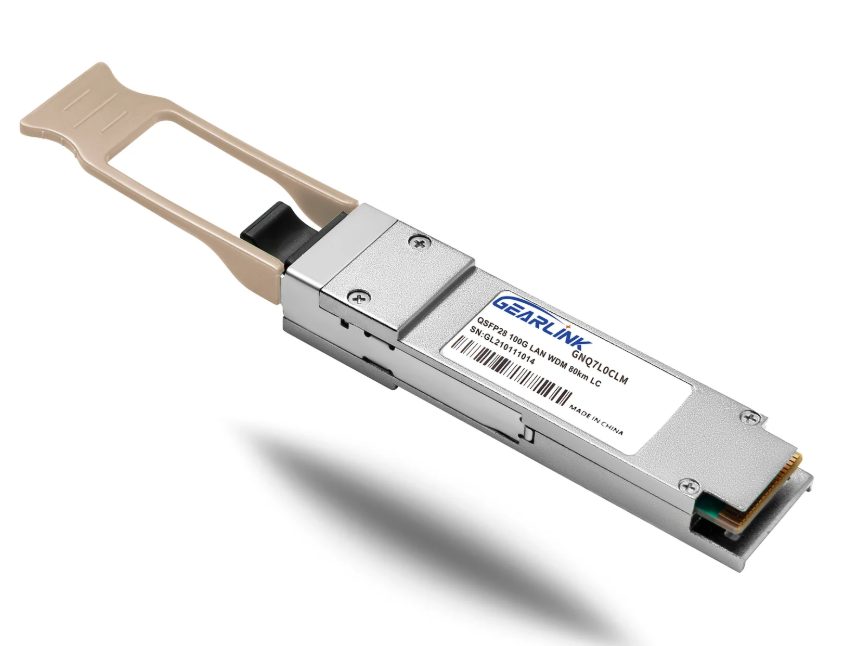
100GBASE-ZR4 optical modules are designed for extended-reach Ethernet links over single-mode fiber, with many implementations supporting distances of up to 80 km.
Connecting Data Centers as One Infrastructure
A data center does not necessarily need to be physically close to another facility to operate as part of the same infrastructure.
Two sites may be separated by dozens of kilometers while still serving the same applications. One facility may host the primary compute environment while another provides storage or disaster recovery capacity.
The challenge is making those sites communicate efficiently enough that users and applications do not have to treat them as completely separate systems.
A high-capacity optical connection can provide the foundation for this type of architecture.
With 100GBASE-ZR4, organizations can establish 100GbE point-to-point links over long-distance single-mode fiber, allowing traffic to move between facilities without relying on multiple lower-speed connections. Typical implementations use four LAN-WDM wavelengths around the 1310nm window and multiplex them onto a duplex single-mode fiber connection.
The result is a much more direct connection between distributed infrastructure.
Why Direct Connectivity Matters
When traffic has to pass through multiple intermediate systems, the network becomes more complicated.
Additional routing equipment may be required. More interfaces need to be configured and monitored. Troubleshooting becomes harder because there are more potential failure points between the source and destination.
Direct high-speed optical connectivity can simplify this architecture.
For example, an organization may connect two data centers through dedicated 100G links instead of building several intermediate aggregation stages. The two sites can then exchange large volumes of data through a predictable and easily monitored path.
This approach is particularly useful when the traffic between locations is persistent rather than occasional.
Storage replication is a good example.
Large datasets may need to be synchronized continuously between primary and secondary facilities. A high-capacity optical link gives this traffic a dedicated path without requiring the organization to redesign its entire network.
Supporting Disaster Recovery
Disaster recovery has traditionally focused on having a second location available if the primary facility becomes unavailable.
Today, simply having another site is not enough.
The secondary environment also needs current data.
This means backup systems, databases, virtual machines, and other critical resources must be synchronized frequently. As data volumes increase, older backup strategies can struggle to keep up.
A 100GbE long-distance link provides significantly more capacity for this type of traffic.
100GBASE-ZR4 modules can support long-distance transmission over single-mode fiber, making them suitable for connecting geographically separated facilities where the distance falls within the supported optical budget. Depending on the specific implementation, host-side FEC may be required to achieve the maximum reach.
This allows disaster recovery systems to move closer to real-time synchronization rather than relying entirely on periodic backups.
Data Center Interconnect Is Becoming More Dynamic
Data center interconnect used to be associated primarily with large cloud providers and telecom operators.
That is changing.
Enterprises increasingly operate multiple facilities because of power availability, regulatory requirements, geographic redundancy, and growing computing demand.
AI is accelerating this trend.
A new GPU cluster may not fit into an existing facility because of power or cooling limitations. Rather than abandoning the existing environment, an organization can place additional compute resources in another building and connect the two sites through a high-capacity optical network.
The network effectively becomes an extension of the original data center.
This makes optical connectivity an important part of expansion planning.
Why Single-Mode Fiber Is Important for Long-Distance Links
Short-distance data center connections can often rely on multimode fiber.
Longer links generally require single-mode fiber because of its lower attenuation and suitability for extended transmission distances.
100GBASE-ZR4 is designed around this type of infrastructure.
Its four optical channels operate in the LAN-WDM range near 1310nm and are combined into a single optical path over duplex single-mode fiber. Common implementations use wavelengths around 1295.56nm, 1300.05nm, 1304.58nm, and 1309.14nm.
This architecture allows high-speed Ethernet to travel considerably farther than conventional short-reach optical solutions.
For organizations with existing single-mode fiber routes, this can provide a practical way to expand inter-site bandwidth.
Keeping Network Management Consistent
A distributed infrastructure does not necessarily have to mean a complicated infrastructure.
One advantage of using Ethernet-based optical connectivity between facilities is that network teams can maintain familiar management practices across locations.
Switches, routers, monitoring systems, and diagnostic tools can continue operating within the same Ethernet environment.
Many 100GBASE-ZR4 modules also provide digital diagnostics, allowing parameters such as temperature and optical power to be monitored through the host system.
For long-distance connections that may be physically difficult to inspect, this visibility is particularly useful.
A network engineer can identify abnormal optical conditions without immediately sending a technician to the remote site.
The Role of 100G in a Mixed-Speed Network
The fact that the industry is moving toward 400G and 800G does not mean every connection needs to operate at those speeds.
Different parts of a network have different requirements.
Servers may use 25G or 100G connections. Data center switching layers may operate at 100G, 400G, or higher. Inter-site connectivity may remain at 100G because the traffic volume and cost structure make that speed appropriate.
100GBASE-ZR4 can therefore coexist with newer generations of Ethernet technology.
Organizations can deploy higher-speed interfaces where they provide the greatest benefit while continuing to use 100G long-reach links for regional connectivity.
This creates a more balanced network rather than forcing every segment to move to the newest available speed.
A Practical Foundation for Distributed Infrastructure
The most useful optical technology is not necessarily the one with the highest specification.
It is the one that matches the network’s actual requirements.
For facilities separated by tens of kilometers, 100GBASE-ZR4 offers a combination of bandwidth and reach that can be difficult to replace with shorter-reach optics. Its QSFP28 form factor, duplex LC connectivity, and single-mode fiber architecture also make it familiar to teams already operating 100GbE networks.
This makes ZR4 particularly useful when the goal is not simply to increase bandwidth, but to connect distributed infrastructure into a more unified environment.
Conclusion
Modern organizations are increasingly distributing computing, storage, and applications across multiple locations. The challenge is making those resources function as parts of the same network rather than isolated facilities. 100GBASE-ZR4 optical modules provide a practical way to address this challenge by delivering high-capacity 100GbE connectivity across long single-mode fiber links. With support for extended reach, LAN-WDM transmission, duplex LC connectivity, and digital diagnostics, they can help organizations build direct connections between data centers, support disaster recovery synchronization, and expand infrastructure across geographically separated sites. As distributed computing becomes more common, long-reach Ethernet connectivity will remain an important part of building networks that operate beyond the boundaries of a single data center.
