

This simple idea is the reason the format attracts beginners. It looks easy. It feels quick. It does not require long rules or deep strategy. But simple does not mean safe, and it does not mean easy profit.
For Indian users, the money side needs special caution. Government of India material says the Promotion and Regulation of Online Gaming Rules, 2026 came into force on 1 May 2026. It also says the Act prohibits online money games while creating a framework for e-sports and online social games.
This guide explains the rules, common versions, betting choices, beginner mistakes, and safer ways to understand the game without treating it as income.
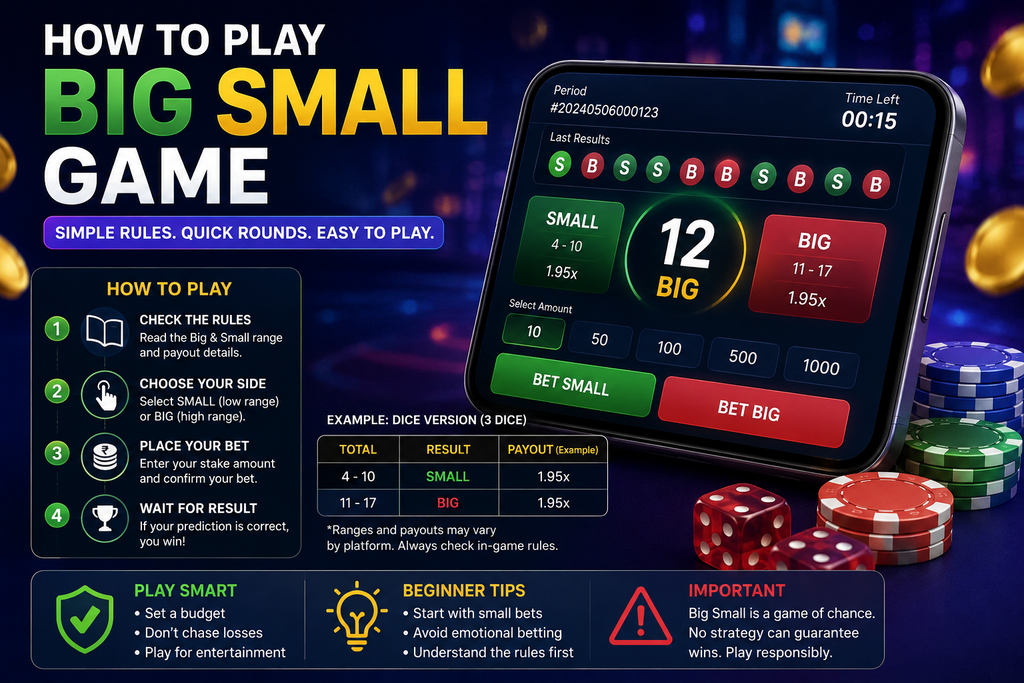
A big small game is one of the simplest prediction formats online. The player usually chooses whether the next result will fall into a “big” range or a “small” range. The result may come from dice, cards, numbers, or a digital draw, depending on the version.
What Is Big Small?
Big Small is a high-low style prediction game. The player does not usually need to build a hand or beat another player. The main task is to predict which result group will appear.
In dice versions, the outcome may depend on the total of several dice. In card versions, the result may depend on whether the next card is higher or lower than a reference point. In number-based versions, the result may be classified into big or small groups by the platform’s rule table.
Big Small is also closely linked to Sic Bo in some casino contexts. SA Gaming’s Sic Bo rules describe Sic Bo as also known as Big/Small, with results based on three dice.
The exact ranges can change by version. One game may count 11 to 17 as Big and 4 to 10 as Small in a dice format. Another may use numbers from 0 to 9 and split them into two groups. This is why the rules page matters.
How the Basic Round Works
The basic round is usually short. The player chooses a side, waits for the result, and sees whether the prediction matched the outcome.
A typical round works like this:
- Open the game rules first.
- Check what counts as Big and Small.
- Choose one result group.
- Place the stake if paid play is legal and allowed.
- Wait for the timer or draw to finish.
- Check the result.
- Stop or continue based on your preset limit.
The most important step is the second one. Never assume the range. The word “Big” may sound obvious, but the actual range is always defined by the game version.
Some formats also include extra choices. These may include exact numbers, odd or even, colors, dice combinations, doubles, triples, or special multipliers. Beginners should avoid these until they understand the main game.
Common Big Small Versions Compared
Big Small is not one fixed game everywhere. It is better to think of it as a family of high-low prediction formats.
| Version | Result source | Main choice | Complexity | Beginner risk |
| Dice Big Small | Two or three dice | Big or Small total | Easy | Players may ignore exact dice rules |
| Number draw | Random number or result table | Big or Small group | Easy | Fast rounds can encourage repeat play |
| Card high-low | Next card or reference card | Higher or lower | Easy to medium | Tie rules may be missed |
| Sic Bo style | Three dice | Big, Small, odd, even, totals | Medium | Many side bets can confuse users |
| Live dealer format | Dealer-run table | Depends on table rules | Medium | Timer pressure can cause rushed bets |
This table is not a ranking by winning chance. It is a guide to learning pressure. A simpler format is easier to understand, but it still carries risk when money is involved.
The best starting point is the version with the clearest rules. If the game screen hides ranges, payout rules, or settlement details, do not play.
What Players Control and What They Do Not
Players control fewer things than they think. This is the main lesson for beginners.
You can control:
- Whether you play or skip the round.
- Which version you choose.
- How much you stake.
- Which result group you pick.
- When you stop.
- Whether you use demo mode.
- Whether you avoid side bets.
You cannot control the result. You also cannot make a random or chance-based outcome safer by repeating the same choice.
This is the core trade-off. The game gives a simple decision, but the outcome remains uncertain. A good player can manage exposure. A player cannot force a result.
That difference matters. A controlled session can still lose. An uncontrolled session can win once and still be dangerous because it teaches the wrong habit.
How to Read the Rules Page
The rules page is the most useful part of the game screen. It tells you what the words mean. It also explains payouts, excluded results, and special cases.
Before playing, check these details:
- What numbers count as Big.
- What numbers count as Small.
- Whether any result is excluded.
- What happens on a tie.
- What the payout is for each choice.
- Whether side bets exist.
- Whether the game has a timer.
- Whether demo mode is available.
Tie rules deserve special attention. In some high-low games, a tie may lose. In others, it may push or return the stake. This small rule can change the real risk.
Payouts also matter. A higher payout usually means a harder result. If an exact number pays much more than Big or Small, that is not a hidden opportunity. It usually reflects lower hit frequency.
Safer Tips for Beginners
Useful tips should reduce mistakes, not promise wins. No tip can know the next result. Good advice focuses on budget, rules, and behavior.
Use these beginner tips:
- Learn one version at a time.
- Use demo mode first if available.
- Start with the main Big or Small choice.
- Avoid complex side bets at the beginning.
- Set a session budget before starting.
- Stop after a fixed loss limit.
- Do not increase stakes after losses.
The safest habit is to decide your limit before the first round. Limits made during play are weaker because emotions are already involved.
Expert Tip: If you cannot explain the result range and payout rule in one sentence, do not use real money on that version.
A simple example helps. Suppose a user sees five Small results in a row. It may feel like Big is “due.” That is not a reliable rule. Short sequences can happen in random systems.
Why “Winning Tricks” Are Risky
Many users search for tricks because the game looks pattern-based. Recent results may appear on the screen. A beginner may think those results reveal what comes next.
That belief is dangerous. Looking at past results can create false confidence. A sequence can look meaningful even when the next round remains uncertain.
Common risky beliefs include:
- Big must follow after many Small results.
- A long streak must end soon.
- Doubling after a loss will recover the session.
- A paid signal group knows the next result.
- A fixed pattern works on every platform.
- A higher stake improves the chance of winning.
None of these should be treated as a dependable method. They can push users into larger bets, longer sessions, and loss chasing.
A safer strategy is not exciting. It is simple. Read the rules, keep stakes small, avoid side bets, and stop at the planned limit.
Big Small Strategy Myths vs Safer Practice
A strategy can help only if it controls behavior. It cannot control the result.
| Claim | Why it sounds tempting | Real risk | Safer practice |
| Follow recent patterns | Results look like trends | Random sequences can mislead | Treat each round as uncertain |
| Double after each loss | One win seems able to recover losses | Stakes can grow quickly | Keep stake size fixed |
| Use signal groups | They promise confidence | They may be fake or manipulative | Avoid outside predictions |
| Chase exact results | Higher payouts look attractive | Lower hit frequency can drain funds | Learn main choices first |
| Play until recovery | It feels disciplined | It is loss chasing | Stop at the preset limit |
| Switch sides after streaks | It feels logical | No guarantee the streak ends | Follow rules, not emotions |
The strongest strategy is self-control. It protects money, time, and decision quality. It does not turn the game into income.
India-Specific Caution for Online Play
India’s current online gaming framework makes this topic sensitive. PIB states that the Promotion and Regulation of Online Gaming Act, 2025 was created to prohibit online money games while promoting e-sports and online social games.
This means Indian users should not assume that a game is allowed because it is available online. A website, app, or payment option is not proof of legality.
Before using any online version, check:
- Is it demo, social, or paid?
- Does it require a deposit?
- Are payment terms clear?
- Is the platform identity visible?
- Are withdrawal rules explained?
- Does it offer spending limits?
- Is the legal status clear for your location?
The safer path is demo or social play. If paid play is unclear, avoid it. No quick game is worth legal or financial trouble.
Common Beginner Mistakes
Most mistakes happen because the game feels too easy. The screen may show only two main choices. That makes users underestimate the risk.
Common mistakes include:
- Playing without reading the ranges.
- Assuming all versions use the same rules.
- Ignoring tie rules.
- Using side bets too early.
- Raising stakes after losses.
- Playing too many fast rounds.
- Treating the game as income.
- Trusting “guaranteed win” claims.
The biggest mistake is chasing losses. This means increasing stakes or playing longer to recover money. It can turn a small loss into a serious one.
Another mistake is confusing entertainment with work. A game that depends on uncertain outcomes is not a reliable earning method.
Responsible Play Rules
Responsible play starts before the round. It is not something to remember after losing control.
Use these rules:
- Treat the game as entertainment only.
- Prefer demo or social formats.
- Do not borrow money to play.
- Keep game money away from bills and savings.
- Set a session budget.
- Set a time limit.
- Stop after the planned loss limit.
- Avoid playing when stressed or angry.
Expert Tip: A safe budget is money you can lose without affecting rent, food, savings, debt payments, or family needs.
If a game becomes hard to leave, stop immediately. If you feel pressure to recover money, stop immediately. If legal status is unclear, avoid paid activity.
Better Alternatives for Skill-Based Play
Some users search for Big Small because they want quick entertainment. Others search because they want to earn money. These are different goals.
For entertainment, casual card games, social games, puzzle games, and demo modes are safer. They do not require deposits.
For income, skill-based work is more realistic. Gaming-related options include content writing, video editing, streaming, tournament support, game testing, and coaching. These paths take effort, but they build useful skills.
A simple rule helps. If improvement depends on your skill, portfolio, audience, or service quality, it may become work. If the result depends on a random draw, it should not be treated as income.
FAQ
What is Big Small?
Big Small is a high-low prediction format. The player usually chooses whether the next result will fall into a defined Big range or Small range. The result may come from dice, cards, numbers, or a live table.
How do you play Big Small?
Read the rules, check the ranges, choose Big or Small, wait for the result, and see whether your prediction matched. Beginners should learn the main choice before trying side bets.
Is Big Small based on skill?
Most versions are mainly chance-based. A player can control the stake, choice, and stop point, but cannot control the result.
Can Big Small tricks guarantee wins?
No. Tricks cannot guarantee the next result. Useful tips can only help users avoid mistakes, manage budget, and stop emotional play.
Is Big Small legal online in India?
Indian users should be careful. Government material says India’s current framework prohibits online money games and supports permitted e-sports and online social games. Check current rules before using any paid platform.
What should beginners check first?
Beginners should check the result ranges, tie rules, payout table, side bets, timer, legal status, and spending controls.
Is Big Small the same as Sic Bo?
Some Sic Bo versions are also called Big/Small because players can bet on high or low dice totals. But not every Big Small game is Sic Bo. Always check the specific rules.
Can Big Small be used to earn money?
No reliable guide should present it as income. The outcome is uncertain, losses are possible, and paid online formats may face legal restrictions in India.
