
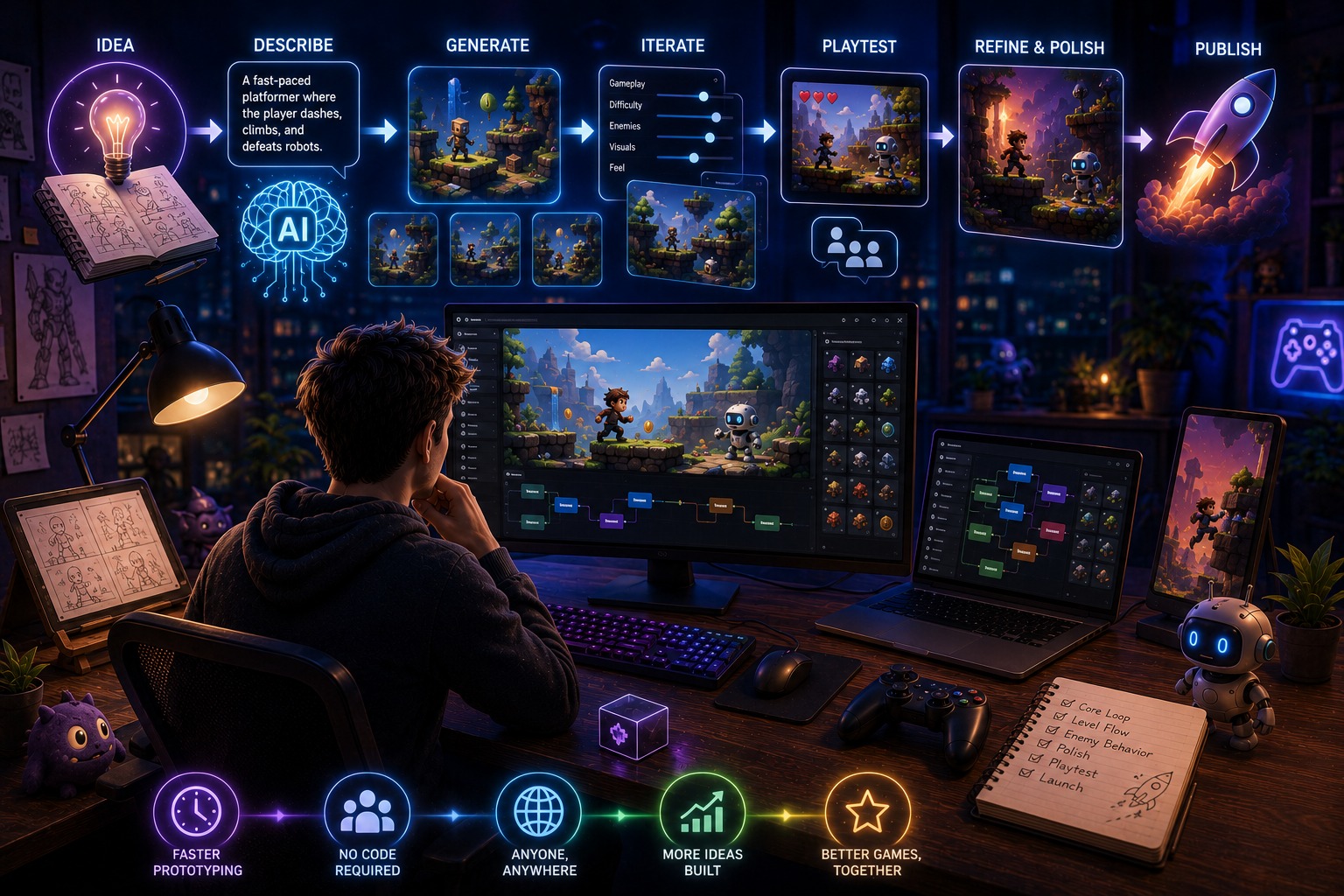
Game design has gone through a handful of real turning points, the shift from arcade cabinets to home consoles, the rise of mobile gaming, the move to live-service models. AI-powered design is shaping up to be another one of those turning points, but it’s different from the ones before it. This isn’t a new platform to build for or a new business model to adopt. It’s a fundamental change in who gets to design games at all, and how quickly an idea can move from thought to something playable.
What Made Previous Eras Different
Every prior shift in game design still required the same underlying skill set to participate, someone still needed to code, still needed technical training, still needed years of practice before their ideas could take shape. New platforms changed where games were played. They didn’t change who was capable of making them. AI-powered design breaks that pattern for the first time, changing the actual population of people who can meaningfully design a game, not just the tools available to the people who already could.
How AI Is Reshaping the Design Process Itself
From Technical Execution to Creative Direction
In traditional development, a huge portion of a designer’s time went toward technical execution, writing the code that made an idea function, debugging it, restructuring it when something didn’t work as intended. AI shifts that balance dramatically. Designers now spend far more of their time on the actual creative decisions, pacing, difficulty, feel, and far less on the technical labor required just to see an idea work at all.
Faster Feedback Loops Change What’s Possible
Design has always improved through iteration, but iteration used to be slow and expensive. Testing five different approaches to a mechanic could take weeks of technical work. Now, testing five approaches can happen in a single afternoon, which means designers can explore far more variations before settling on what actually feels right. That speed doesn’t just save time, it changes the quality of decisions being made, since more options get tested before anything gets locked in.
Prototyping Becomes Part of Ideation
In earlier eras, prototyping happened after an idea was already fairly well formed, since building even a rough version required real commitment. AI-powered tools collapse that gap, letting prototyping become part of the ideation process itself. Designers can test a half-formed idea immediately, see how it feels, and let that feedback shape the concept further, rather than fully designing something on paper before ever testing whether it works.
What This Era Looks Like in Practice
Games Built by People Outside Traditional Studios
A growing share of genuinely well-designed games are now coming from individuals and small teams with no traditional studio backing at all. Ragdoll Punch is a good example of what this era actually produces, a physics-driven mechanic with real personality and polish, built by someone who didn’t need a studio’s technical resources to bring it to life.
Design Quality No Longer Tied to Team Size
For most of gaming history, production value correlated fairly closely with team size and budget. That correlation is weakening. A single designer using an AI game maker can now produce something with a level of polish that used to require an entire team, which is genuinely reshaping expectations about what a solo creator can realistically achieve.
Faster Cycles From Concept to Release
Games that once took months to move from concept to a shareable version can now reach that point in days. This compression doesn’t just benefit solo creators, it changes how design decisions get validated, since real player feedback can inform a project far earlier in its development than traditional pipelines ever allowed.
What Hasn’t Changed, and Won’t
Creative Judgment Still Sits With the Designer
AI can execute a described mechanic, but it doesn’t decide whether that mechanic is actually fun, whether the pacing feels right, or whether a design choice serves the experience as a whole. Those judgment calls still come entirely from the person designing the game, exactly as they always have.
Playtesting Remains Just as Essential
Faster prototyping doesn’t replace the need to watch real players interact with a game and adjust based on what actually happens. If anything, faster iteration makes honest playtesting more valuable, since there’s more opportunity to act on feedback quickly rather than discovering problems after a design is already locked in.
Design Fundamentals Are Still the Foundation
Understanding pacing, balance, player psychology, and feel still takes time to develop, regardless of how quickly an idea can be prototyped. AI changes how fast a concept becomes playable. It doesn’t change what makes that concept good once it exists.
Why This Era Is Likely to Keep Accelerating
As more designers experience how much faster iteration can move, expectations shift accordingly. Waiting weeks to test an idea starts to feel unnecessary once faster alternatives exist, which pushes the entire field toward tighter, faster design cycles as a new standard rather than an exception. At the same time, the growing number of well-designed games coming from outside traditional studios keeps proving that this shift produces real quality, not just faster output, which reinforces adoption further.
Final Thoughts
The new era of AI-powered game design isn’t defined by AI making creative decisions on a designer’s behalf. It’s defined by removing the technical friction that used to slow down every step between an idea and a playable version of it. The designers who succeed in this era will still be the ones with strong instincts for what makes a game genuinely fun, they’ll just be able to act on those instincts faster, and with far fewer barriers standing in the way.
