
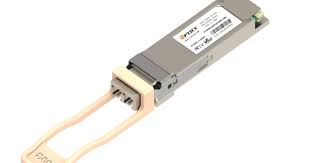
In modern data centers, the demand for faster, denser, and more efficient interconnects continues to grow alongside cloud computing, AI, and 5G technologies. Among the various 100G Ethernet solutions, the 100GBASE-SR BD (short for Bidirectional Short Reach) optical transceiver stands out for its ability to deliver high-speed data transmission over standard duplex multimode fibers while minimizing infrastructure upgrades. This transceiver plays a key role in reducing cost and complexity during the transition from 10G and 40G to 100G networks.
What Is 100GBASE-SR BD?
The 100GBASE-SR BD is a 100G BiDi QSFP28 optical interface standard designed for short-range data transmission, typically up to 100 meters on OM4 multimode fiber. Unlike traditional parallel optics that use 8 or 12 fibers (as in 100GBASE-SR4), the SR BD standard achieves 100 Gbps transmission through just two fibers in a duplex LC configuration. It accomplishes this using wavelength division multiplexing (WDM) and bidirectional signaling, sending and receiving optical signals simultaneously at two different wavelengths—typically 850 nm and 900 nm—on each fiber.
This design dramatically cuts down the required number of fibers, allowing data centers to reuse existing duplex LC cabling originally deployed for 10G or 40G Ethernet. As a result, network operators can upgrade to 100G bandwidth with minimal rewiring or disruption.
Working Principle and Technology
Each 100GBASE-SR BD transceiver integrates four 25G NRZ electrical lanes on its host interface. These electrical signals are then converted via dual-wavelength VCSELs (Vertical-Cavity Surface-Emitting Lasers) into two 50G PAM4 optical signals. The combined link provides the full 100 Gbps line rate.
The key innovation is the bidirectional capability: each of the two LC fibers supports both transmission and reception. One fiber sends 850 nm light and receives 900 nm signals, while the other does the opposite. This wavelength pairing enables full-duplex communication while using only a single duplex multimode link.
Because of this efficiency, SR BD modules are well suited to short-distance interconnects—typically 70 meters on OM3, 100 meters on OM4, and up to 150 meters on OM5 multimode fibers fibermall.com.
Advantages in Modern Data Centers
The advantages of using 100GBASE-SR BD modules extend beyond raw performance. Some of the most relevant benefits include:
- Fiber Reuse and Cost Savings: By leveraging existing duplex LC multimode cabling, SR BD eliminates the need for expensive and bulky MPO/MTP connectors used by SR4 solutions. This can save up to 75% of the cabling cost during network upgrades.
- Simplified Cabling Management: Using two fibers per link instead of eight drastically reduces cable density, allowing for cleaner setups and easier maintenance.
- Backward Compatibility: SR BD technology supports smooth migration from 10G SR or 40G BiDi networks. Modules like the Cisco QSFP-40/100-SRBD provide dual-rate operation (40G and 100G), ensuring a seamless upgrade path.
- Operational Efficiency: With lower insertion loss requirements and support for PAM4 modulation, these modules achieve excellent power efficiency and reliability for rack-to-rack or spine-leaf interconnects.
Technical Specifications
Typical 100GBASE-SR BD modules follow the QSFP28 (Quad Small Form-factor Pluggable) form factor, widely adopted for 100G Ethernet. Standard specifications include:
| Parameter | Typical Value |
| Form Factor | QSFP28 |
| Data Rate | 100 Gbps (4×25G NRZ electrical, 2×50G PAM4 optical) |
| Wavelengths | 850 nm and 900 nm |
| Connector Type | Duplex LC |
| Fiber Type | OM3/OM4/OM5 multimode fiber |
| Transmission Distance | 70 m (OM3), 100 m (OM4), 150 m (OM5) |
| Operating Temperature | 0°C to 70°C |
| Protocols | IEEE 802.3bm 100GBASE-SR compliant |
These transceivers comply with key MSA and IEEE standards and typically consume under 3.5W of power, making them ideal for power-sensitive data center environments.
Real-World Application Scenarios
The 100GBASE-SR BD solution is primarily deployed in data center short-reach interconnects—connecting top-of-rack (ToR) switches to aggregation or spine switches. It helps enterprises and cloud providers efficiently scale their networks while maintaining compatibility with existing cabling systems.
For example, in a leaf-spine data center architecture, operators may deploy QSFP28 SR BD optics for 100G uplinks between servers and ToR switches, while simultaneously enabling future scalability toward 400G infrastructure through BiDi-compatible 400G modules such as QSFP-DD SR4.2.
Additionally, in financial institutions or AI cluster environments where ultra-low latency and stability are critical, SR BD’s short-reach architecture ensures consistent performance without the need for specialized connectors or complex cabling conversions.
Comparison with Other 100G Multimode Solutions
| Feature | 100GBASE-SR4 | 100GBASE-SR BD | 100GBASE-SWDM4 |
| Fiber Count | 8 (MPO) | 2 (duplex LC) | 2 (duplex LC) |
| Transmission Principle | 4×25G parallel | 2×50G bidirectional WDM | 4×25G WDM |
| Max Distance (OM4) | 100 m | 100 m | 100 m |
| Cabling Cost | High | Low | Low |
| Upgrade Compatibility | Requires new cabling | Reuses LC fiber | Reuses LC fiber |
| Market Maturity | Very mature | Rapidly growing | Limited |
While SR4 remains the most common and cost-effective module in large-scale deployments, SR BD strikes an excellent balance between performance and cabling simplification. SWDM4 offers similar capabilities but has limited vendor adoption and higher component costs compared to SR BD.
Future Outlook
As data centers evolve toward 400G and 800G networks, the bidirectional optical technology pioneered by SR BD will continue to influence next-generation standards. Future modules such as 400G QSFP-DD BiDi SR4.2 extend the same duplex cabling benefits while quadrupling capacity. This compatibility ensures that investments in duplex multimode infrastructure today will remain relevant for years to come.
In summary, 100GBASE-SR BD has become one of the most practical and scalable solutions for short-reach 100G interconnects. By combining innovative bidirectional WDM design with the familiar duplex LC interface, it bridges the gap between legacy systems and modern high-speed networks—maximizing return on investment while preparing data centers for the next generation of optical networking.
