
Taking a first step toward certification doesn’t have to be overwhelming. If you’re searching for CPR Certification Halifax, you’re already ahead of most people — because the majority of Canadians have never taken a formal CPR course, even though cardiac arrest can happen anywhere, to anyone, without warning.
Halifax is a city of hospitals, universities, a major port, and a growing professional workforce. Whether you work in healthcare, construction, education, or hospitality, the odds are good that your employer — or your own conscience — is nudging you toward certification. Here’s everything you need to know to get it done.
Why CPR Training Matters More Than Most People Realize
The statistics are sobering. According to the Heart & Stroke Foundation of Canada, approximately 35,000 cardiac arrests occur outside of hospital settings in Canada each year. Survival rates are dramatically higher when bystander CPR begins within the first few minutes of collapse — yet fewer than half of cardiac arrest witnesses attempt it.
The reason isn’t indifference. It’s lack of training. People hesitate because they’re not confident. CPR certification fixes that. It gives you both the skill and the psychological readiness to act when it counts most.
That’s not a small thing. In a workplace, a gym, a family kitchen, or a university residence hallway in Halifax — being trained means you don’t freeze.
What Nova Scotia Law Requires for Workplace First Aid
Under the Nova Scotia Occupational Health and Safety (OHS) Act and its regulations, employers are legally required to provide first aid services appropriate to the size and risk classification of their workplace. The Nova Scotia Department of Labour, Skills and Immigration oversees compliance and enforcement.
For most workplaces, this means maintaining a trained first aider on site during all working hours. The required level of certification scales with the number of employees and the hazard rating of the work environment. A small retail operation has different requirements than a construction site or a fish processing facility — but neither can operate without a plan.
Employers who fail to maintain compliant first aid coverage face potential OHS Act citations, which can carry serious consequences including stop-work orders and financial penalties. Certification isn’t just a personal benefit. It’s a legal baseline.
Which CPR and First Aid Course Is Right for You?
Not every course is the same, and choosing the wrong one can mean taking it again. Here’s a practical breakdown of the main options:
CPR/AED Level C The most widely required level across Canadian workplaces and community settings. It covers adult, child, and infant CPR, as well as automated external defibrillator (AED) operation. Most Nova Scotia employers requiring a standalone CPR credential will specify Level C.
Emergency First Aid + CPR/AED Level C A one-day course covering the fundamentals of life-threatening emergency response — choking, severe bleeding, unconsciousness, and CPR. Appropriate for lower-risk environments and individuals who need a quick, recognized credential.
Standard First Aid + CPR/AED Level C The most comprehensive option. Delivered over two days, it covers everything in Emergency First Aid plus wound care, fractures, burns, head and spinal injuries, sudden medical emergencies, and more. This is the course most employers and OHS regulations specify for higher-risk workplaces.
BLS (Basic Life Support) Designed for healthcare providers — nurses, paramedics, dental workers, medical students, and allied health professionals. BLS focuses on team-based CPR, high-performance resuscitation, and advanced airway management. It’s typically required for clinical placement and healthcare employment, and it renews annually.
Choosing the right course means reading your employer’s requirements or your professional licensing body’s standards before you register. If you’re unsure, Standard First Aid covers every scenario — it never hurts to be over-prepared.
What Is Blended Learning and Why Does It Work?
Most people picture a first aid course as a full day in a classroom. That model has largely been replaced by blended learning — and for good reason.
With a blended format, you complete the theoretical component online at your own pace before attending an in-person skills session. That means you’re not spending hours in a classroom watching videos. You arrive already understanding the concepts, and the in-person time is spent entirely on hands-on practice with manikins, AEDs, and real scenario work under direct instructor feedback.
Coast2Coast First Aid & Aquatics delivers all courses using this format. For working professionals, parents, and shift workers in Halifax, it makes certification significantly more manageable. You can complete the theory during a lunch break or an evening without taking time off work.
Certifications earned through this format are fully recognized — they’re issued under Canadian Red Cross or Heart & Stroke Foundation authority and accepted by employers and regulatory bodies across Nova Scotia.
How Long Does Certification Last?
Standard First Aid and CPR/AED certifications are valid for three years from the date of issue. BLS certification through Heart & Stroke is valid for one year.
Many employers require renewal before expiry to maintain continuous OHS compliance — if your card lapses, you typically need to retake the full course rather than a shorter renewal session. Mark the date when you certify and book your renewal a few weeks early. It’s a small habit that saves a significant hassle.
What Happens on the In-Person Skills Day?
Most participants are surprised by how practical — and how fast — the in-person session is. You’ll spend your time doing, not watching.
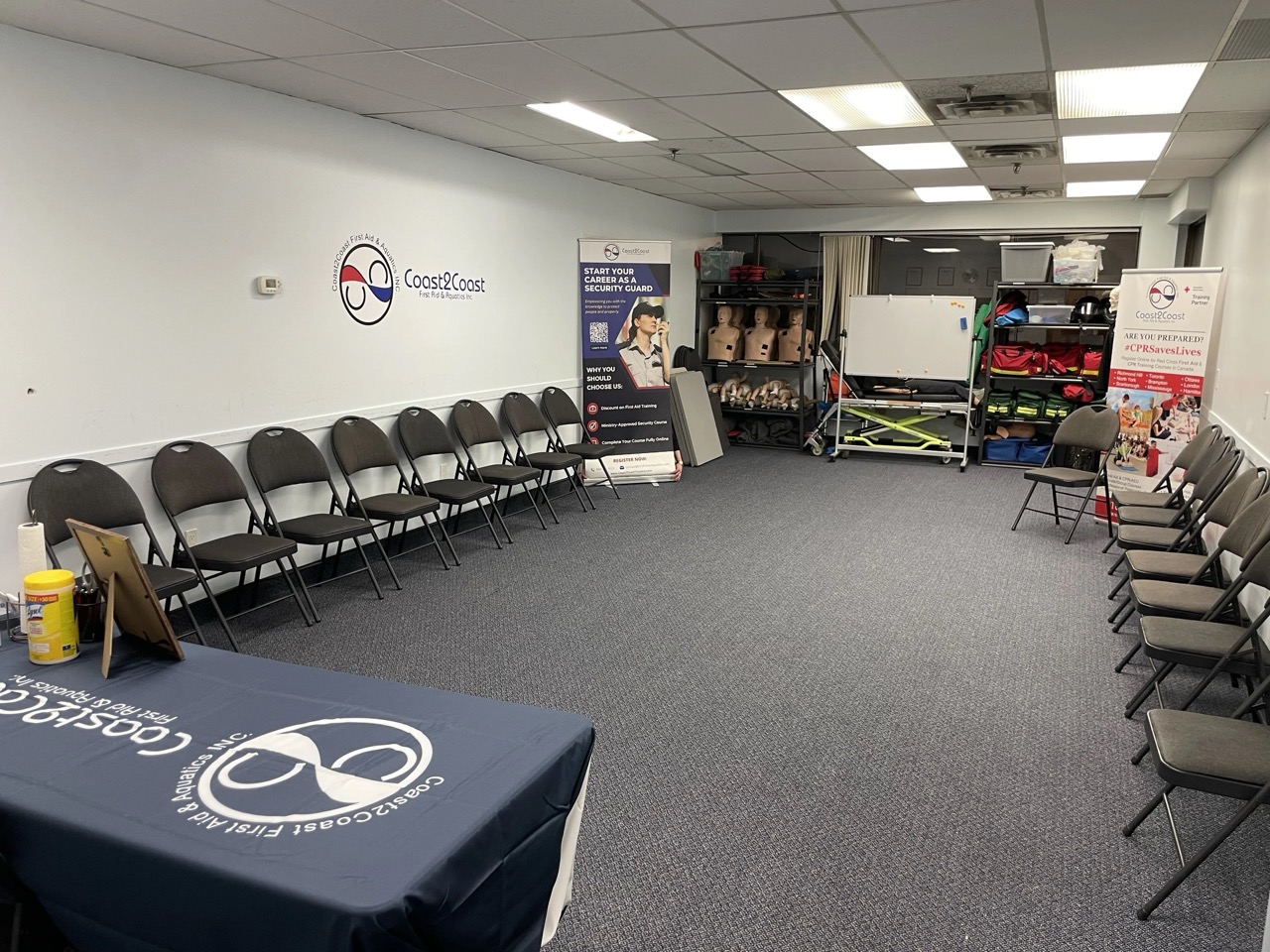
Expect to practise CPR compressions and rescue breathing on manikins, run through AED operation including pad placement and shock delivery, and work through bandaging, patient assessment, and choking response with direct instructor coaching. Group sizes are small enough that you get individual attention and real feedback on your technique.
Wear clothing you can move in. Bring a photo ID. And go in with an open mind — instructors are experienced at bringing first-timers up to speed without making anyone feel behind.
Where Can You Train in Halifax?
If you are looking for CPR or first aid certification near the North End, Quinpool Road, or communities across the Halifax Regional Municipality, you may reach out to Coast2Coast First Aid & Aquatics in that area.
FAQS
Q: Is CPR certification mandatory in Nova Scotia workplaces?
A: Under the Nova Scotia Occupational Health and Safety Act, employers must provide first aid services appropriate to their workplace size and hazard level. This typically requires having at least one certified first aider on site during working hours, with the required certification level scaling based on workforce size and risk classification.
Q: What is the difference between CPR Level C and Standard First Aid?
A: CPR Level C is a standalone certification covering cardiopulmonary resuscitation and AED use for adults, children, and infants. Standard First Aid is a comprehensive two-day course that includes CPR Level C along with wound care, fractures, burns, head injuries, and a broad range of medical emergencies. Standard First Aid is required in most higher-risk Nova Scotia workplaces.
Q: How long is CPR certification valid in Nova Scotia?
A: CPR/AED and Standard First Aid certifications are generally valid for three years. BLS certification renews annually. It is advisable to book renewal before expiry, as a lapsed certification typically requires completing the full course again rather than a shorter renewal session.
Q: Can I complete my CPR course online?
A: The theory component of most first aid and CPR courses can be completed online through a blended learning format. The hands-on skills session must be completed in person with a certified instructor. The resulting certification is fully recognized by the Canadian Red Cross and Heart & Stroke Foundation and accepted by employers and regulatory bodies across Nova Scotia.
Q: Do healthcare workers in Halifax need a different CPR certification than the general public?
A: Yes. Healthcare providers — including nurses, paramedics, dental professionals, and medical students — typically require BLS (Basic Life Support) certification, which covers high-performance team CPR and advanced resuscitation techniques. BLS is a separate credential from CPR Level C and renews annually rather than every three years.
