
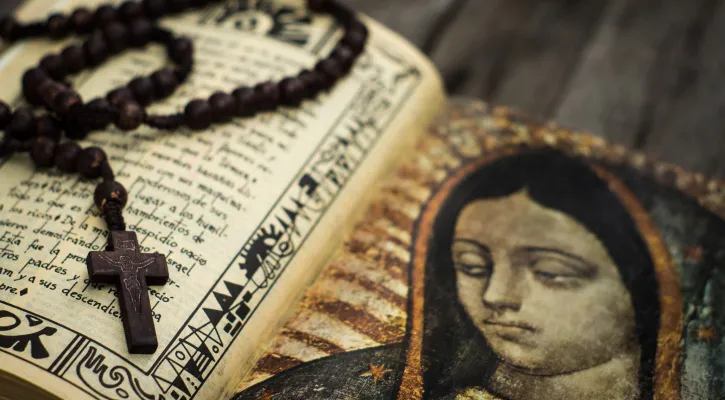
My grandmother always had her rosary tied around the bedpost in her bedroom. Every morning she would take it down and sit in her armchair by the window and pray the rosary. She didn’t say a word the rest of the day. I never really understood why she did that. And to be honest, I still don’t really get it. But I guess that’s kind of the point.
I have never been able to get to the bottom of this prayer. I still don’t really get it now. This is one of the things about the Rosary that I find so peculiar. It doesn’t really lend itself to being explained. It’s something best lived out in repetition rather than in trying to figure it out by breaking it down.
Most of our spiritual struggles have something to do with performance.
Most of our struggles with God to do with performance in some way. We worry that we’re not praying well enough. That our prayers are not good enough. We worry that God isn’t going to answer our prayers because we’re not good enough. The Rosary is a way of praying that cuts through all of this. In many areas of life, people discover that building better habits through intentional practices can create a stronger sense of discipline, consistency, and focus over time. It is a repetitive prayer, using words that have already been written, in a structure that has already been worked out. It doesn’t allow for much room for performance in the way that most forms of prayer do. There are the words. There is the structure. Go through the decades.
Everything these days is trying to draw more customized original content from its users. In contrast, the Rosary does not even try to draw original or customized content from us. In fact, it does not even try to gauge whether or not we are praying correctly or sincerely enough. In short, it does not care whether or not God is answering our prayers or not. What the Rosary does is to provide us with a simple and consistent structure that holds the life of Christ for us as we pray. The words are already there for us. In addition to these words, the Rosary contains fifteen decades of prayer (and twenty if one prays the Luminous Mysteries as well). Each of these decades of prayer is preceded by a set of meditation words that fix a single scene from the life of Christ in our minds as we pray the subsequent Ave Maria’s. Our attention to the mystery that we are meditating on as we pray through the decades is all that is required.
As one researcher puts it, giving one’s hands a simple task to do frees up the mind for more profound work. That’s exactly what the Rosary is designed to do.
The five Decades and the five Mysteries
Most people are surprised by the Rosary in that the vocal prayers are in the background of our prayer while we are meditating on the mysteries of Christ and His Mother.
For most people, the words and the decade structure are the backbone of the Rosary. The verbal prayers—Ave Marias and Paters and Aves—can become sort of background noise. The more important work of the prayer is reflecting on the Mystery you are meditating, holding the scene from scripture in your mind as you pray the decades. This kind of meditation is one of the most subtle and complex of all the Christian spiritual practices. Many people have spent years learning how to practice lectio divina (sacred reading), and Ignatian imaginative prayer. But the Rosary is different. The Rosary is a complete package of deeply spiritual material that has been wrapped up in a very simple form that is very simple, and very portable. It can be used by anyone, anywhere, at any time. Praying the Rosary is not difficult to learn to do. Any child can learn to pray the Rosary, and any person dying in their bed with shaking hands can learn to pray the Rosary as well. The Rosary is an incredibly beautiful, and simple spiritual practice, designed by someone with a great deal of skill and spiritual insight.
(And I am repeating the word “remarkable” here. The Rosary is so simple that it could not possibly be remarkable in the way I am trying to explain. And yet it is.)
Why it keeps coming back
Another myth regarding the Rosary is that it is an old devotion that does not apply to most Christians today in this century. Devotions can become out of fashion from time to time, and in fact most devotions that have ever been written down have fallen into disuse from time to time. But then a war comes along, or a great personal crisis befalls Christians and all of a sudden they are clinging to a devotion such as the Rosary as if it were the only thing that could save them. It seems to be the case with the Rosary that it has the greatest following during the worst of times.
I don’t know much about the Pope, but I do know that Pope John Paul II was a huge fan of the Rosary. This was the man who lived through the Nazi and Soviet occupations of his country, attempted to be assassinated by the Soviet Union and suffered the rest of his life with much pain and discomfort. But when he wasn’t busy being a superhero, he was praying with his Rosary. The Pope said the Rosary was his ‘favourite’ prayer. I can see why.
This prayer is good for hard times and holds up under pressure. The Rosary does not bring a lot of pyrotechnics or turn arounds in people’s lives but it is always there when you need it and return to it and the simple and familiar decades.
The Physical Object Matters More Than You Admit
Choosing a rosary for prayer is often a choice of physical aspects of the rosary that will determine whether or not the rosary will be used. For most people, the material that the rosary is made of is not the deciding factor in whether or not they will use the rosary for prayer. Rather, the physical characteristics of the rosary such as its weight, texture, and the feel of the crucifix in the hand are all factors that determine the prayer experience of the rosary user. Choosing a well-made rosary that will serve as a beautiful anchor for the prayerful is an important decision, and one that should be taken with consideration of the physical aspects of the rosary.
A few things worth considering when choosing one:
- Wood beads tend to feel warmer and less slippery, which some people find easier to count in low light or half-asleep
- Metal or crystal beads are more durable for daily use and travel — they develop a kind of patina from use that wood sometimes doesn’t survive
- Smaller rosaries work well for pocket or purse carry; full-sized ones suit a dedicated prayer space at home
- Handmade options carry a kind of intentionality that mass-produced ones sometimes lack — though a worn, mass-produced rosary from someone who prayed it daily carries its own weight
So the first thing to note is that you will probably go through a number of rosaries throughout your life, and so it is worth spending a little time and effort to search for the best. So look for the highest quality materials, and the best construction to ensure that your rosary will last a long time. Ideally, it should last longer than most of the other things you own.
The quiet accumulation of something real
What does the Rosary deliver that people expect before they start praying the Rosary. This is the space that either will make people stop praying the Rosary or they will become more devout as they realize what it is bringing to them. I find this to be a very fascinating topic.
| What people expect | What the Rosary actually delivers |
| Immediate emotional consolation | Gradual, structural peace that accumulates over weeks |
| New theological insight | Deeper familiarity with mysteries you were certain you already understood |
| A complex, personal prayer | A framework that holds you upright when your own words fail |
| Spiritual novelty | Continuity with centuries of ordinary, quietly faithful people |
Lastly, there’s that final row of prayers that have always really mattered to me for some reason. The final decades have been recited by every generation of Catholics ever – by poor, uneducated peasants in medieval Europe, by healthy, well-educated, modern monks from around the world. There have been people who’ve faced all manner of suffering and loss who’ve prayed these decades, and people who’ve faced no suffering or loss whatsoever who’ve prayed these decades. They’re your decades, whether you realize it or not.
I have no idea what this practice does for people, and I’m not even sure what it did for my grandmother. But it did shape her, in profound ways that I can sense but can’t quite grasp. And when she could no longer practice, she stopped. I have come to understand that there are practices that do not require us to have any sort of intellectual grasp of them. We can treat them with respect, and then we simply show up to them every day, morning and night.
