
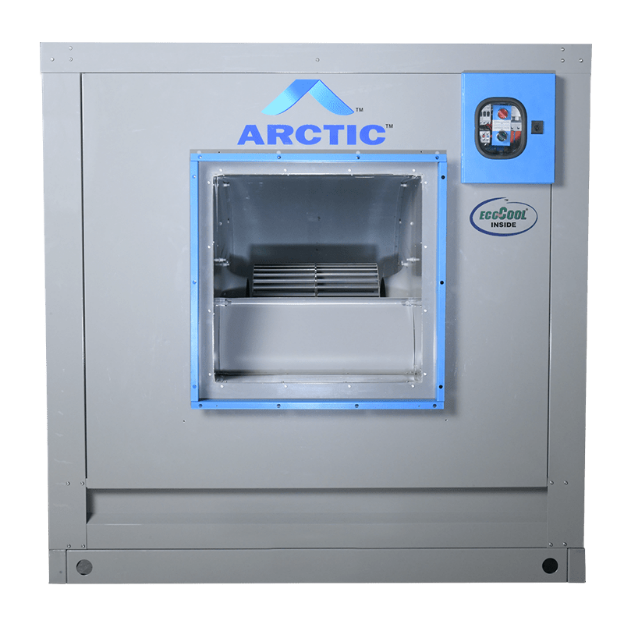
Choosing the right cooling equipment for a commercial property requires careful consideration of the space, airflow requirements, climate, operating conditions, and long-term maintenance. A system that works well for a small retail area may not provide sufficient airflow for a warehouse, factory, workshop, or large event venue.
A commercial air cooler can provide an effective cooling solution for suitable environments, particularly where high-volume airflow and fresh-air circulation are important. Commercial evaporative cooling systems use water evaporation to reduce incoming air temperature and fans or blowers to distribute the cooled air.
Before purchasing, businesses should evaluate the application rather than selecting equipment based only on price or physical size.
What Is a Commercial Air Cooler?
A commercial air cooler is designed to provide cooling and air movement for larger spaces than typical residential units. Depending on the model and application, commercial cooling equipment can be used in warehouses, factories, workshops, retail areas, restaurants, offices, and event venues.
How Does Commercial Evaporative Cooling Work?
Evaporative cooling uses water and airflow to reduce the temperature of incoming air. Warm air passes through wet cooling pads, where evaporation removes heat from the air. A fan or blower then moves the cooled air into the occupied space.
Unlike conventional air conditioning, evaporative cooling is designed around continuous air movement and fresh-air circulation. This makes ventilation an important part of the overall system design.
Commercial systems can be configured in different ways depending on the building. Portable units can provide flexible spot cooling, while ducted systems can distribute cooled air through multiple areas.
If you are comparing equipment for a larger facility, you can explore the commercial air cooler range to review commercial and ducted evaporative cooling options.
Where Are Commercial Air Coolers Commonly Used?
Commercial cooling equipment can be useful across several types of environments. Warehouses may require high-volume airflow across large floor areas, while factories and workshops may need cooling around heat-producing equipment or workstations.
Retail spaces and restaurants can have different requirements because customer comfort and air distribution are important. Event venues may need temporary or high-capacity cooling during periods of high occupancy.
Commercial air coolers can also be considered for areas where opening doors, large entrances, or open structures make conventional enclosed-room cooling less practical.
The application should always determine the type and capacity of equipment selected. Factors such as occupancy, heat sources, ventilation, and building layout can significantly affect cooling requirements.
What Factors Determine the Right Commercial Cooler Size?
Choosing the correct capacity is one of the most important purchasing decisions. A unit that does not provide enough airflow may struggle to cool the intended area, while excessive capacity may increase unnecessary operating costs.
The first consideration is the total area that needs cooling. However, floor area alone does not provide a complete picture. Ceiling height affects the volume of air in the space and should be included in the assessment.
Occupancy is another important factor. A busy facility with many people may have a different cooling load from a lightly occupied space of the same size.
Heat-producing equipment can also influence requirements. Machinery, lighting, ovens, production equipment, and other heat sources can increase the amount of cooling needed.
Ventilation and building openings should be assessed as well. Large doors, windows, open sides, and exhaust systems can affect how cooled air moves through the space.
Local climate is also relevant because evaporative cooling performance depends on temperature and humidity. In general, evaporative systems perform more effectively when incoming air is relatively dry.
Finally, consider the airflow required to move cooled air throughout the space. The right system should be selected according to its expected application and operating conditions rather than a single advertised coverage figure.
What Features Matter in a Commercial Air Cooler?
Once the required capacity has been established, businesses should compare equipment based on performance, construction, usability, and maintenance.
Airflow and Cooling Capacity
Air delivery is particularly important for large commercial spaces. A cooler must be capable of moving enough air to reach the intended areas and maintain effective circulation.
When comparing models, review airflow specifications alongside the installation environment. Ducted applications may also require consideration of static pressure because duct resistance can affect actual air delivery.
Cooling performance should be considered together with airflow. High airflow without suitable cooling conditions may not provide the desired comfort, while insufficient airflow can prevent cooled air from reaching important areas.
Construction and Durability
Commercial equipment may operate for long periods and face demanding environmental conditions. Construction quality therefore deserves careful attention.
Consider the materials used in the body, the quality of the cooling pads, motor and fan components, water tank or water supply system, and accessibility of service components.
Maintenance-friendly construction can make routine cleaning and servicing easier. Components that are difficult to access may increase service time and operational inconvenience.
For businesses evaluating different commercial cooling applications, Arctic provides evaporative cooling solutions covering portable, ducted, indirect, spot, and other cooling requirements.
How Can Businesses Manage Operating Costs?
Purchase price is only one part of the cost of owning commercial cooling equipment. Businesses should consider electricity, water, maintenance, servicing, and expected operating hours.
Energy consumption should be compared against the required airflow and cooling application. A system with a suitable balance between air delivery and power consumption may be more economical to operate over time.
Water consumption is another consideration for evaporative systems. Depending on the equipment and operating environment, water may be required continuously or periodically.
Maintenance costs should also be included. Cooling pads, pumps, tanks, filters, fans, motors, and electrical components may require regular inspection or servicing.
Operating schedules can further influence expenses. Using equipment only where and when cooling is required may help avoid unnecessary consumption.
Proper placement can also contribute to efficient operation. When airflow is directed toward the areas that actually require cooling, businesses may be able to use their equipment more effectively.
Why Is Ventilation Important for Commercial Evaporative Cooling?
Ventilation is a fundamental part of evaporative cooling. Unlike a conventional air conditioning system that may recirculate indoor air, evaporative cooling introduces fresh air and relies on continuous air movement.
As cooled air enters the building, warmer air needs an appropriate path to leave. Without adequate air exchange, humidity can increase and cooling effectiveness may decline.
Ventilation can be supported through doors, windows, exhaust systems, roof openings, or purpose-designed building airflow paths, depending on the application.
The relationship between cooler placement and exhaust points should therefore be considered during planning. Simply installing a high-capacity cooler without considering where the air will travel and exit may result in uneven cooling.
Businesses should evaluate ventilation alongside cooling capacity, especially in warehouses, factories, workshops, and other large spaces.
How Should Commercial Air Coolers Be Maintained?
Routine maintenance helps protect cooling performance and equipment reliability. Commercial environments can expose cooling systems to dust, debris, mineral deposits, and continuous operating demands.
Cooling pads should be inspected and cleaned according to the manufacturer’s recommendations. Accumulated deposits can affect water distribution and evaporation.
Water tanks and related components should also be cleaned regularly. Pumps should be inspected to ensure that water is circulating correctly.
Fans and motors require periodic checks, while electrical connections should be inspected as part of appropriate servicing procedures.
Airflow should also be monitored. A noticeable reduction in performance may indicate dirty cooling pads, blocked airflow, mechanical issues, or other maintenance requirements.
Seasonal maintenance can be especially useful before periods of heavy cooling demand. Establishing a regular servicing schedule helps businesses identify issues before they affect daily operations.
How Can You Compare Commercial Air Cooler Models?
A structured comparison makes it easier to identify equipment that matches the business’s actual needs.
Start with air delivery and cooling capacity. Determine whether the model can provide the required airflow for the intended area and operating conditions.
Next, consider power consumption and water requirements. These factors influence ongoing operating costs and should be compared alongside the expected cooling output.
Coverage requirements should be assessed according to the building’s layout. A large open warehouse may have different requirements from a multi-room commercial property.
Controls and operating features can affect convenience. Consider whether the system offers appropriate controls for the way the business operates.
Maintenance requirements should also be reviewed. Ask how frequently cooling pads, water systems, fans, and other components need servicing.
Warranty coverage and after-sales support are important for commercial equipment because downtime can affect business operations. Confirm what support is available, how replacement components are obtained, and whether trained service personnel are accessible. For assistance with evaluating your commercial cooling requirements, you can use the contact option to discuss the application and available solutions.
Frequently Asked Questions About Commercial Air Coolers
What is a commercial air cooler used for?
A commercial air cooler is used to provide cooling and high-volume airflow in larger spaces such as warehouses, factories, workshops, retail areas, restaurants, and event venues. Evaporative models are particularly useful where fresh-air circulation and suitable environmental conditions are available.
Are commercial air coolers suitable for factories and warehouses?
Yes, commercial air coolers can be suitable for factories and warehouses when properly sized and installed. Large spaces often require high airflow, appropriate ventilation, and strategic equipment placement to distribute cooled air effectively.
How do I choose the right air cooler capacity?
Consider the area’s dimensions, ceiling height, occupancy, heat-producing equipment, ventilation, climate, and required airflow. Capacity should be selected according to the complete application rather than floor area alone.
Does humidity affect commercial evaporative cooling?
Yes. Humidity can affect evaporative cooling performance because the cooling process depends on water evaporation. Drier air generally provides greater evaporative cooling potential, while high humidity can reduce the temperature reduction that can be achieved.
How often should a commercial air cooler be serviced?
Service frequency depends on operating hours, environmental conditions, water quality, dust levels, and equipment type. Cooling pads, water systems, pumps, fans, motors, and electrical components should be inspected regularly according to manufacturer recommendations.
