
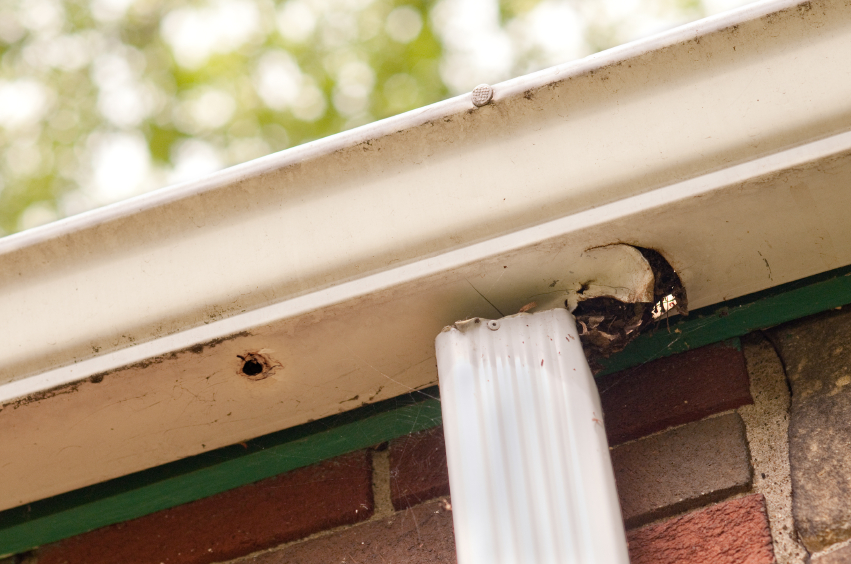
Damaged gutters don’t automatically need to be replaced. Many common problems—including isolated leaks, loose hangers, damaged downspouts, and minor alignment issues—can often be repaired when the rest of the system remains in good condition. However, repeatedly repairing gutters that have widespread deterioration may cost more over time than installing a new system.
The right decision depends on the type of damage, its extent, the condition of the gutter material, and how well the overall drainage system still performs. Homeowners should evaluate the complete system rather than making a replacement decision based on a single damaged section.
When Does Gutter Repair Make Sense?
Repair is usually the logical first option when damage is localized.
A relatively small problem doesn’t justify replacing functional gutter runs throughout the property.
Common repairable issues include:
- leaking corners;
- loose hangers;
- detached downspouts;
- minor sagging;
- damaged end caps;
- isolated holes;
- separated connections;
- incorrect pitch in a limited section.
The key consideration is whether fixing the affected area restores normal drainage.
If the gutter continues performing correctly after repair, replacement may not provide enough additional benefit to justify the expense.
Small Leaks Can Often Be Repaired
Leaks frequently develop around joints, corners, end caps, and downspout connections.
Sealants can deteriorate over time, and seasonal expansion and contraction may gradually affect connections.
An isolated leak is generally a repair issue rather than a reason to replace the entire system.
However, the number of leaks matters.
If new leaks repeatedly appear throughout an aging gutter system, individual repairs may only provide temporary relief.
Homeowners looking for more information about common gutter problems and repair options can visit https://elitegutterscare.com/services/gutter-repairs/.
Loose Hangers Don’t Always Mean New Gutters Are Needed
Gutters are attached to the roofline using hangers and fasteners.
Over time, individual attachment points can loosen because of:
- wet debris;
- standing water;
- snow and ice;
- strong weather conditions;
- normal material movement.
If the gutter itself hasn’t become severely deformed, replacing or repositioning the affected hardware may restore proper support.
The underlying cause should still be identified.
For example, installing new hangers without correcting a drainage problem that allows water to remain inside the gutter may lead to the same issue later.
Sagging Gutters Require Closer Inspection
A sagging gutter creates a low point where water can collect.
Minor sagging may result from loose hardware or insufficient support and can sometimes be corrected without replacing the gutter.
Severe sagging is different.
If the gutter has permanently bent or lost its original shape, simply adding new hangers may not restore proper drainage.
The longer water remains in a sagging section, the greater the stress placed on the surrounding mounting points.
Downspout Problems Are Often Repairable
Downspouts can become loose, disconnected, dented, or damaged without affecting the rest of the gutter system.
In many cases, the damaged component can simply be repaired or replaced individually.
Common downspout issues include:
- separated elbows;
- loose wall attachments;
- damaged lower sections;
- leaking connections;
- missing extensions.
Blockages should also be ruled out before assuming physical damage is responsible for poor drainage.
A clogged downspout can create symptoms that look like a larger gutter problem.
When Is Replacement the Better Choice?
Replacement becomes more practical when deterioration is widespread rather than isolated.
Warning signs include:
- numerous leaks throughout the system;
- extensive corrosion;
- multiple sagging sections;
- severe deformation;
- recurring separation from the fascia;
- frequent repair requirements;
- insufficient drainage capacity.
At some point, continuing to repair individual components no longer addresses the condition of the system as a whole.
A new installation can provide a more reliable long-term solution.
Consider the Condition of the Fascia
Sometimes what appears to be a gutter problem actually begins with the surface supporting it.
If fascia boards have deteriorated because of repeated moisture exposure, gutter fasteners may no longer hold securely.
The result can be recurring separation even after hardware is replaced.
Signs of possible fascia problems include:
- peeling paint;
- dark staining;
- soft wood;
- visible deterioration;
- fasteners repeatedly becoming loose.
The supporting material should be inspected before gutters are reattached or replaced.
Overflow Doesn’t Necessarily Mean the Gutters Are Damaged
Overflowing gutters are sometimes replaced unnecessarily.
Before considering replacement, homeowners should determine why the overflow occurs.
Common causes include:
- accumulated leaves;
- blocked downspouts;
- incorrect gutter pitch;
- debris around outlets.
Cleaning or adjustment may solve these problems without requiring major work.
However, clean and correctly aligned gutters that consistently overflow during heavy rain may be undersized for the roof.
In that case, replacement with a higher-capacity system could be appropriate.
Age Alone Shouldn’t Determine the Decision
There is no universal age at which every gutter system needs replacement.
Material, installation quality, weather exposure, and maintenance history all affect service life.
An older system that remains securely attached, drains correctly, and has only minor isolated problems may continue performing well.
Conversely, a newer system with poor installation or inadequate capacity may require substantial changes much sooner.
Physical condition and drainage performance provide more useful information than age alone.
Compare the Frequency of Repairs
Occasional gutter repair is normal.
Constant repair is different.
If homeowners repeatedly pay to fix new leaks, loose sections, or failing connections, replacement may eventually provide better value.
A useful question is:
Are repairs extending the life of an otherwise functional system, or are they temporarily keeping a failing system together?
The answer can help determine which approach makes more financial sense.
Replacement Can Correct Existing Design Problems
Replacing gutters provides an opportunity to improve more than their physical condition.
An older system may have been incorrectly sized or designed for the roof.
A new installation can address issues such as:
- insufficient gutter capacity;
- too few downspouts;
- poor downspout placement;
- long unsupported runs;
- problematic drainage near roof valleys.
This is particularly valuable when the property has experienced drainage problems even when the existing gutters were clean and undamaged.
Seamless Gutters May Reduce Future Leak Points
Homeowners replacing older sectional gutters may consider a seamless system.
Sectional gutters contain multiple connections along straight runs. Over time, these joints can become potential leak points.
Seamless gutters are fabricated in longer continuous sections, reducing the number of connections required.
Corners and downspout outlets still need joints, but eliminating unnecessary seams can simplify the system and reduce potential maintenance points.
Think About the Complete Water Path
Whether gutters are repaired or replaced, the ultimate objective is the same: move water safely away from the home.
That means evaluating more than the gutter channel itself.
The complete path includes:
- roof runoff;
- gutters;
- downspouts;
- extensions or drainage pipes;
- final discharge areas.
Repairing a gutter won’t solve a problem caused by a downspout releasing water into poorly drained soil beside the foundation.
Similarly, installing new gutters won’t automatically correct poor grading around the property.
Professional Evaluation Can Prevent Unnecessary Replacement
A professional inspection can help separate repairable defects from signs of widespread failure.
This is particularly useful when several symptoms appear at the same time.
For example, overflow, sagging, and leaks may seem to indicate that complete replacement is necessary. But if the primary cause is a severe blockage combined with several loose hangers, cleaning and targeted repairs may restore the system.
Conversely, numerous small defects throughout an aging system may make replacement the more practical choice.
For homeowners looking for Professional Gutter Services, including gutter inspection, cleaning, repair, installation, and drainage solutions, additional information is available at https://elitegutterscare.com/.
Final Thoughts
Gutter repair and replacement aren’t competing solutions—each is appropriate under different conditions. Localized leaks, loose hardware, minor sagging, and individual damaged components can often be repaired successfully. Widespread corrosion, recurring leaks, extensive deformation, inadequate capacity, and constant repair requirements are stronger arguments for replacement.
The best decision comes from identifying why the system is failing and evaluating its overall condition. Fixing the actual cause rather than simply treating the most visible symptom can extend gutter life, improve drainage, and help prevent unnecessary water damage around the home.
