
For facility managers, commercial real estate developers, and architects operating in the US market in 2026, the pressure to optimize building efficiency has never been higher. Between soaring commercial electricity rates and stringent new energy regulations (such as New York’s Local Law 97 or California’s Title 24), traditional HVAC setups are quickly becoming financial liabilities.
When upgrading a facility’s climate control, sourcing top-tier equipment from a reliable VRF air conditioning supplier is the first step toward long-term operational savings. But is this complex, highly advanced system the right choice for your specific building?
In this comprehensive B2B guide, we bypass the standard marketing pitches. We will explore the core technology behind VRF, compare its real-world ROI against traditional chillers and RTUs, and uncover the hidden maintenance realities you need to know before executing a commercial HVAC upgrade.
What is a VRF Air Conditioning System?
The Technology Explained
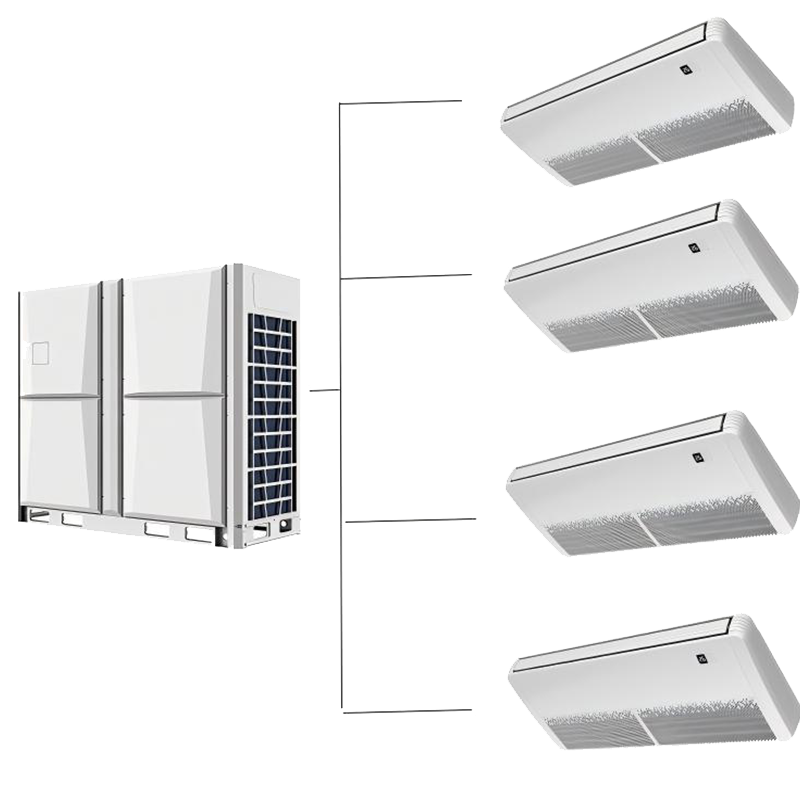
Variable Refrigerant Flow (VRF) is an enterprise-grade, ductless (or minimal-duct) HVAC technology that uses refrigerant as the sole cooling and heating medium.
Instead of traditional single-stage compressors that blast at 100% capacity and then shut off, a VRF central air conditioner utilizes an inverter-driven compressor. This allows the system to dynamically adjust its speed and deliver the exact “flow” or volume of refrigerant required by each independent indoor zone based on real-time thermal loads.
VRF vs. VRV: Clearing the Industry Confusion
During the procurement process, you will inevitably see the terms VRF and VRV used interchangeably. Technologically, there is zero difference between them:
VRV (Variable Refrigerant Volume): This is a trademarked term owned by Daikin, the manufacturer that invented the technology.
VRF (Variable Refrigerant Flow): This is the generic, open industry term used by all other global manufacturers (such as LG, Mitsubishi, and Samsung) for the exact same system architecture.
Heat Pump vs. Heat Recovery: The B2B Game Changer
When specifying a commercial VRF system, engineers must choose between two fundamentally different configurations:
Standard Heat Pump VRF
A Heat Pump VRF system can provide exceptional heating and cooling, but it can only operate in one mode at a time. All indoor units connected to the outdoor condenser must be either cooling or heating. This is suitable for large, open-plan spaces with uniform temperature requirements.
Heat Recovery VRF (Simultaneous Operation)
For complex commercial buildings, a VRF heat recovery system is the ultimate game-changer. By utilizing specialized Branch Selector (BS) boxes, this system achieves simultaneous heating and cooling.
If a sun-facing executive office requires cooling, but a shaded perimeter room requires heating, the system will actually capture the rejected heat from the cooling zone and transfer it directly to the heating zone. This internal energy recycling drastically reduces the load on the outdoor compressor, pushing energy efficiency ratios to unparalleled levels.
The Real-World Pros and Cons for Facility Managers
To make an informed CAPEX decision, facility managers must look at both the engineering triumphs and the operational realities of VRF technology.
The Engineering Advantages
Unmatched Efficiency (High IEER): By eliminating leaky ductwork—which accounts for up to 30% of energy loss in standard systems—and utilizing inverter technology, VRF systems achieve some of the highest Integrated Energy Efficiency Ratios (IEER) in the industry.
Architectural Flexibility: Because refrigerant pipes are a fraction of the size of sheet metal ducts, a commercial VRF system requires significantly less ceiling plenum space, allowing for higher ceilings or easier retrofits in historic buildings.
Precise Zoning: Occupants gain granular control over their specific zones, preventing the classic “office thermostat wars” and eliminating the energy waste of conditioning empty conference rooms.
The Hidden Drawbacks (What Brands Don’t Tell You)
Vendor Lock-in (Proprietary Protocols): Commercial HVAC drawbacks are rarely discussed upfront. With VRF maintenance, you are locked into the manufacturer’s proprietary communication protocols. If a mainboard fails, you cannot hire a general mechanical contractor; you must hire a technician specifically certified in that brand’s diagnostic software.
The Single Point of Failure: A VRF system relies on an extensive network of brazed copper piping. If a severe refrigerant leak occurs in the main trunk line, the entire building (or the entire module) loses climate control.
Expert Engineering Tip: “As experienced commercial HVAC consultants, we always warn our clients: 80% of VRF failures are not factory defects, but installation errors. Specifically, failing to flow nitrogen during copper brazing will leave oxidation flakes inside the pipes, which eventually clog the sensitive Electronic Expansion Valves (EEVs). Always choose an installer with specific VRF credentials.”
VRF vs. Traditional Rooftop Units (RTUs) and Chillers
How does VRF stack up against the commercial mainstays?
| Feature | Commercial VRF System | Traditional RTU (VAV) | Commercial Chiller Plant |
| Zoning Capability | Ultimate (Room-by-room control) | Moderate (Requires VAV boxes) | High (Requires complex hydronics) |
| Space Requirements | Minimal (Small copper piping) | Massive (Large air ducts required) | Large (Mechanical rooms & towers) |
| Simultaneous Cool/Heat | Yes (with Heat Recovery models) | No (Requires costly reheat coils) | Yes (Requires 4-pipe design) |
| Initial Cost (CAPEX) | High | Moderate | Very High |
| Maintenance Complexity | Very High (Proprietary software) | Moderate (Standard components) | High |
2026 Commercial VRF Installation Costs & ROI
When budgeting for a commercial HVAC upgrade, the VRF installation cost is undeniably a premium investment. Due to the specialized labor required for extensive copper piping and complex control wiring, the initial VRF system price is typically 20% to 40% higher than a traditional RTU replacement.
However, Total Cost of Ownership (TCO) is where VRF wins. Facilities typically observe a 25% to 40% reduction in monthly HVAC electrical consumption. Depending on local utility rates and available state rebates for high-efficiency heat pumps, the Return on Investment (ROI) crossover point usually occurs between 4 to 7 years.
Frequently Asked Questions (FAQ)
How long does a commercial VRF system last?
Under rigorous commercial preventative maintenance schedules, a high-quality VRF system has an expected operational lifespan of 15 to 20 years.
Does a VRF system bring in fresh outdoor air?
No. By default, VRF indoor units only recirculate and condition existing indoor air. To meet ASHRAE commercial building ventilation codes, the VRF system must be paired with a Dedicated Outdoor Air System (DOAS) to introduce fresh, filtered outside air.
Can any commercial HVAC technician repair a VRF system?
It is highly discouraged. VRF systems utilize closed-loop communication software and sensitive variable-frequency drives. Repairs should only be conducted by technicians who have undergone factory certification for that specific VRF brand.
