
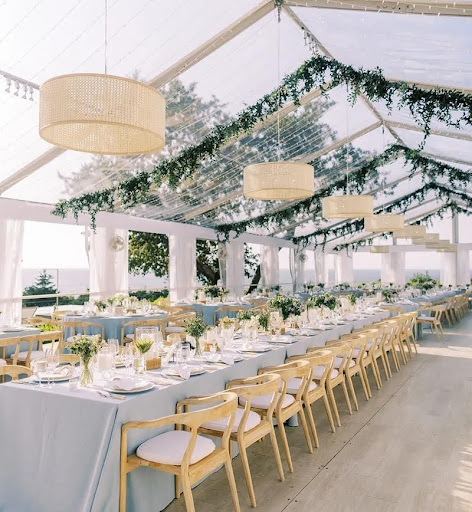
Most outdoor events fit comfortably within what conventional tent systems deliver. A sailcloth tent for a wedding, a pole tent for a large party, a clear top for a setting where the landscape is part of the experience — these formats handle the majority of what the Fairfield County event market produces. But there’s a category of event where the requirements exceed what any of those formats can reliably provide, and where the right answer isn’t a larger version of a conventional tent but a structurally different approach entirely.
The events that fall into this category share certain characteristics. Guest counts that require clear spans the traditional tent systems don’t achieve cleanly without interior support columns interrupting the floor plan. Program requirements — presentations, performances, exhibition setups — that need unobstructed sightlines and flexible internal configuration that column placement makes impossible. Climate control requirements that the partially open geometry of conventional tent structures can’t support efficiently. Visual standards that call for something reading as architecture rather than temporary infrastructure.
For these events, Losberger clearspan structures represent the appropriate solution rather than a premium alternative. They’re not a more expensive version of a tent — they’re a structurally different category that solves problems conventional tents can’t solve, for events where those problems are real rather than theoretical. greenwichtent.com is where event planners and hosts in Fairfield County access Greenwich Tent Company’s Losberger clearspan capability alongside the full range of other tent structures — with the experience to identify which events genuinely require this format and which ones are better served by other options.
What Makes the Losberger System Specifically Valuable
The engineering behind Losberger clearspan structures produces spans that would require multiple interior columns in a conventional tent system — column-free interiors across widths of forty, fifty, or sixty feet that leave the entire floor plan available for whatever the event requires. For a corporate gala where the stage, the dining area, and the bar all need to function simultaneously without structural obstruction determining where each goes, this flexibility is the difference between designing the event and working around the tent.
The modular geometry of the system is the second structural advantage. Losberger structures can be configured in lengths that exactly match the event’s requirements rather than approximating them with a standard tent size. This precision matters both for aesthetic reasons — a structure that fits the space exactly reads as more intentional than one that’s close — and for practical ones, since oversizing wastes budget and undersizing creates floor plan compromises.
The enclosed geometry of Losberger clearspan structures supports climate control in ways that conventional tent forms can’t match. A fully enclosed clearspan building with proper HVAC integration maintains consistent interior temperature regardless of exterior conditions — which makes it the right structural choice for events in October, November, or early spring where the alternative is hoping the weather cooperates rather than planning for the full range of what Connecticut’s climate produces in those months.
How the Glass Wall Option Changes the Character of the Space
The option to configure a Losberger clearspan structure with glass walls produces something that sits between a fully enclosed building and an open-air tent — the thermal performance and climate control of an enclosed structure alongside the visual connection to the surrounding landscape that glass allows.
For properties where the setting is part of what makes the event worth hosting there — a waterfront estate, a property with significant landscape, a location with an architectural or natural backdrop worth preserving as part of the guest experience — glass walls allow the clearspan’s structural advantages without the visual closure that solid walls impose. Guests experience the setting throughout the evening rather than only on arrival, which changes the character of the space substantially.
The visual quality of a glass-walled clearspan structure at night — lit from inside with guests visible through the glass, the structure itself illuminated against the surrounding landscape — produces a specific and compelling aesthetic that other tent forms don’t replicate. Greenwich Tent Company installs and supports Losberger clearspan structures across Fairfield County for events where the program, the scale, or the season makes this format the appropriate choice.
