
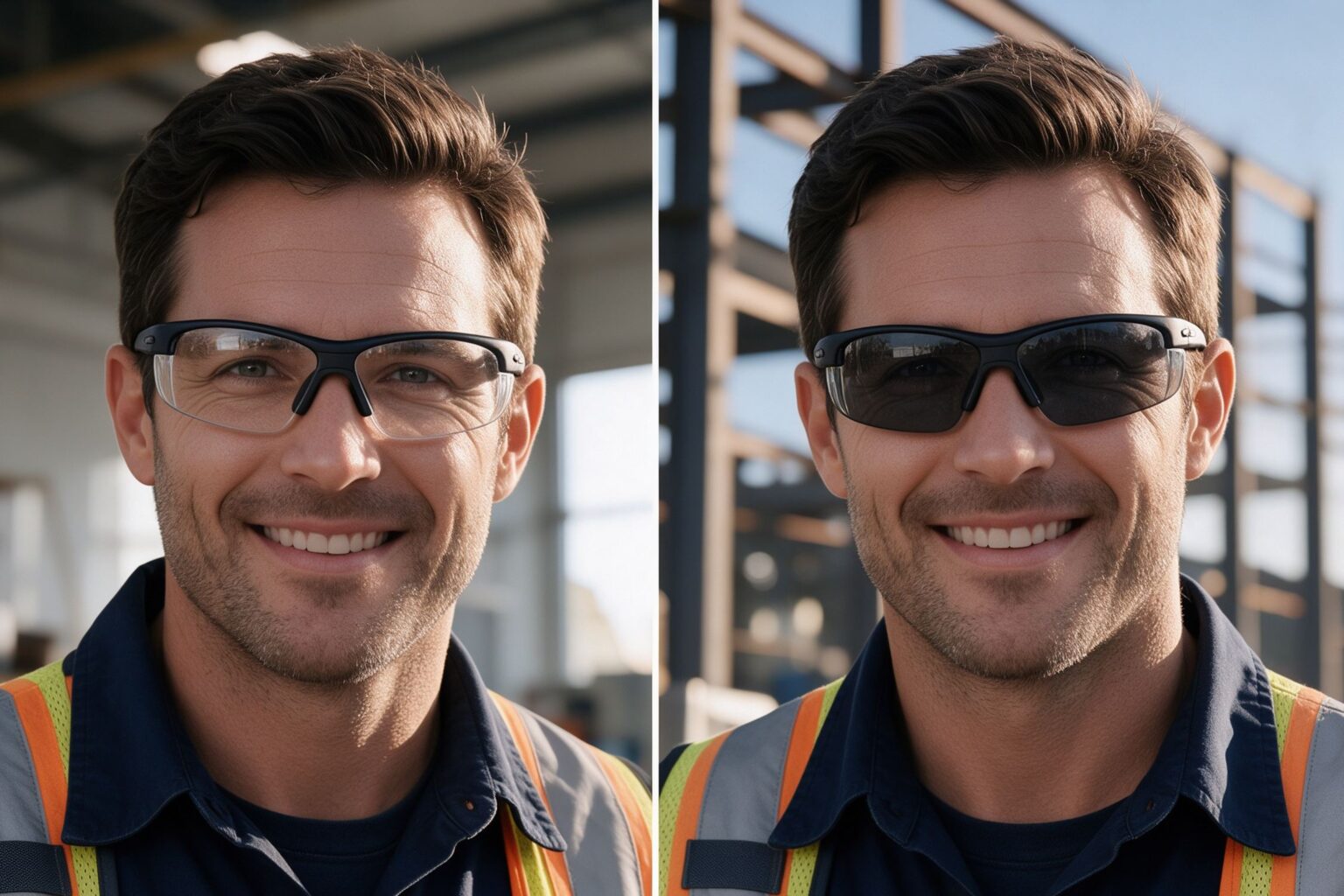
Work environments can change quickly. A worker may move between bright outdoor areas, shaded work zones, vehicles, and indoor spaces during the same shift. Transition prescription safety glasses can provide vision correction while adapting lens darkness to changing light, making them worth considering for jobs that involve frequent movement between different environments.
The important question is whether photochromic lenses suit the actual conditions of the job. They can be convenient, but their performance depends on UV exposure, temperature, workplace lighting, prescription needs, and the protection required for the task.
How Transition Prescription Safety Glasses Work
Photochromic lenses contain materials that react to ultraviolet radiation. When exposed to sufficient UV light, the lenses darken. When UV exposure decreases, they gradually return toward a clearer state.
This automatic adjustment can reduce the need to switch between clear and tinted eyewear throughout the day. However, the transition is not instantaneous, and the amount of darkening depends on the lens technology and environmental conditions.
What Affects Lens Performance?
|
Factor |
Effect on Performance |
|---|---|
|
UV exposure |
Drives the lens-darkening response |
|
Temperature |
Can affect activation and recovery |
|
Indoor lighting |
Usually produces less activation |
|
Vehicle windows |
May reduce UV reaching the lens |
|
Lens technology |
Determines response characteristics |
|
Work environment |
Determines whether adaptive tint is useful |
Understanding these variables helps workers decide whether adaptive lenses match their routine rather than assuming they will behave identically in every setting.
When Transition Prescription Safety Glasses Make Sense
The strongest use case is a job that involves regular movement between outdoor and indoor environments. Construction, maintenance, utilities, landscaping, transportation, and other mobile roles can expose workers to changing light throughout a shift.
Automatic tint adjustment can be convenient because the wearer does not need to carry or change between separate clear and sun-protective pairs. Prescription correction remains available while the lens adapts to outdoor UV exposure.
However, convenience should not replace hazard assessment. The eyewear still needs to provide the protective characteristics required for the job, and adaptive tint alone does not determine whether a product is appropriate for a particular workplace hazard.
Signs Adaptive Lenses May Be Useful
Consider them if your workday involves:
- Frequent movement between indoor and outdoor areas
- Extended exposure to daylight
- Changing light levels throughout a shift
- A need to maintain prescription correction continuously
- Limited opportunity to change eyewear during tasks
- Preference for one adaptable pair instead of multiple pairs
When Adaptive Lenses May Not Be Ideal
Photochromic lenses are not automatically the best solution for every outdoor worker. Some jobs require a consistently dark lens in strong sunlight, while others involve conditions where a specific tint or contrast profile is more appropriate.
Vehicle use is another consideration. Many windshields and vehicle windows filter significant amounts of UV radiation, which can reduce activation of some photochromic lenses. A driver who spends much of the workday inside a vehicle may therefore need a different lens solution.
Specialized indoor environments can also change the calculation. Certain settings may require clear lenses, specific filters, or other optical characteristics rather than relying primarily on outdoor UV exposure.
Protection Still Comes First
Adaptive tint is a visual feature, not a substitute for safety protection. Before selecting eyewear, identify the hazards present in the workplace and determine what level of impact, splash, dust, or other protection is required.
The frame and lens should be suitable for applicable safety requirements. Workers should also confirm that the prescription design is compatible with the protective frame and that the eyewear remains securely positioned during normal movement.
A Practical Safety Checklist
Before choosing adaptive safety eyewear, check:
- Is the lens appropriate for the relevant workplace hazards?
- Does the frame provide adequate coverage?
- Is the prescription current and accurately made?
- Does the eyewear remain stable when bending and turning?
- Will it work with other required PPE?
- Is the lens response suitable for expected light conditions?
- Will the eyewear be used inside vehicles or behind windows?
This separates genuine safety requirements from features that are primarily about convenience.
Comfort and Fit Matter During Long Shifts
Safety eyewear that is uncomfortable is less likely to be worn consistently. Frame width, bridge fit, temple pressure, weight, and lens positioning all influence whether glasses remain comfortable over several hours.
Prescription positioning matters too. If lenses sit incorrectly in front of the eyes, the wearer may experience unnecessary visual discomfort even when the prescription itself is accurate. A stable frame helps maintain the intended optical position.
For workers who spend long periods outdoors, comfortable transition safety glasses for clear outdoor vision are particularly relevant when evaluating how eyewear handles changing light while remaining practical for extended wear.
Transition Safety Glasses vs. Separate Eyewear
The choice between adaptive lenses and separate clear and tinted safety glasses depends on workflow.
|
Consideration |
Transition Safety Glasses |
Separate Clear and Tinted Pairs |
|---|---|---|
|
Changing light |
Automatically adapts |
Requires changing eyewear |
|
Convenience |
One primary pair |
Multiple pairs |
|
Prescription |
Available in the same eyewear |
Depends on each pair |
|
Tint control |
Less predictable |
More predictable |
|
Vehicle use |
Requires consideration |
Easier to select specific lenses |
|
Best fit |
Variable light exposure |
Clearly defined conditions |
Neither approach is universally superior. The better option is the one that matches the worker’s actual exposure and daily routine.
Questions to Ask Before Buying
- How much of the workday is spent outdoors?
- How often do lighting conditions change?
- Is the eyewear used while driving?
- What workplace hazards need protection?
- Does the frame fit securely with other PPE?
- Would a fixed tint provide more predictable performance?
- Can the prescription be incorporated accurately into the safety design?
CA Glasses is a practical option for workers evaluating safety eyewear around prescription, protective, and changing-light requirements. Its range allows workers to consider optical correction and workplace protection together rather than treating them as unrelated choices.
Conclusion
Transition prescription safety glasses can be a sensible choice when a workday involves frequent changes in natural light and the convenience of adaptive lenses is genuinely useful. Their main advantage is reducing the need to switch between clear and tinted eyewear while maintaining prescription correction.
Also read: The Benefits of Mobile Physiotherapy Services
They are not the right solution for every job. UV exposure, vehicle use, required safety protection, lens response, fit, and specific visual demands should all be considered before choosing adaptive eyewear. A workday-based assessment provides a more reliable answer than selecting lenses based on convenience alone.
